

Compete for the Future You Want
Empower human+AI growth to build a future you support.


The Age of AI is dawning. The light is still soft. The landscape unclear. Shapes are emerging. We are crafting our future now. Data isn’t sufficient to make fully-informed choices, but that cannot delay directional decisions. You determine your destiny. Are you choosing to craft a future you can justify to your kids?
“AI’s promise is real, and we are only in the early days. Put AI to work to grow.” — PwC, 2025 Global AI Jobs Barometer.
Proactive Not Passive
Conflicting fears about job displacement AND being out-paced by AI-enhanced rivals are surging. Sentiments affect outcomes as emotions tip decisions initially justified rationally (especially when facts are contradictory, lagging or lagging).
Are you letting Big Tech decide your future? Is that wise? Or are you waiting for government to enforce (relevant?) rules with sufficient societal safeguards?
Your intentional strategic choices as a leader must decide:
how to balance the composition of your human-AI workforce;
the degree to which AI drives or is driven;
whether to assess human workers for their capabilities or as liabilities;
if AI utilisation predominantly generates growth or cuts costs; and
how well AI’s expense and errors are calculated and risk-assessed.
The AI-related job displacement narrative is loud but limited, concerning but also contradictory, for now. AI may be the new layoff excuse (rather than RTOs, tariffs or energy disruption?) or response to perceived pressure from hyped-up investors or tech-driven long-stalled organisational restructuring:
13% employment decline for 22-25 year old workers with the most AI-exposed jobs where AI automates vs augments [Stanford, NBER, 2025].
700 customer-service reps replaced by a chatbot at Klarna were being rehired a year later [Fortune, 2025].
Salesforce, Meta other tech firms cut AI-exposed teams [CNBC, 2025].
~90% of firms cite no material AI impact on employment or productivity over last 3 years [NBER, 2026].
What are expected short- and long-term benefits as your company transforms?
Cutting or Compounding
So far, the data does not validate the swelling fears. Context-relevant data for most sectors is very limited. For now, AI can only replace a noticeable portion of humans’ work in very specific roles, sectors and segments. AI’s hyped potential of 10-20x gains for coders justifying core tech companies’ layoffs is more likely 10-15% with a much lower multiplier across most other types of work.
~20% not 20x productivity gain for (~100,000) coders using AI tools.
Some teams saw productivity decrease [Stanford, Desinov June 2025].
Only 7.8% rise in PR throughput (core productivity measure) despite 65% increase in AI usage (400 firms Nov 2024 to Feb 2026 [DX 2026].
How much can AI achieve doing which tasks/roles and at what cost and when?
“Stanford’s Digital Economy Lab found that agentic coding tasks consume 1,000 times more tokens than standard code reasoning and chat, a finding that puts hard numbers on a cost problem the AI industry is only beginning to confront.” — Quartz article ‘Agentic AI’s compute demands are growing faster than anyone projected‘ May 15, 2026.
Compounding AI impact can be beneficially innovation-directed rather than cutting jobs to absorb (fast-increasing) capital costs of-especially agentic-AI.
High-profile announcements to replace human jobs with AI may seem to permit your firm or competitors making similar cuts. However, a short-term visceral ‘cut-cos-you-can’ reaction misses the point and doesn’t register where we are. The inflection point is imminent, but the tipping point has not been reached or determined directionally, yet.
To advance now, your company must reaffirm its vision to create what and serve whom guided by which core corporate values - such as trust. A long-term-big-picture strategic plan is required to decide what viable, sustainable combination of talent, skills and technologies together can achieve the mission.
Leaders must choose how to achieve the most beneficial AI impact and what strategies can be balanced to multiply and mitigate:
IBM has tripled graduate hires, warning that hollowing out entry-level destroys the middle-management bench [Fortune, Feb 2026].
Walmart is redeploying associates through Live Better U and an internal AI-skills track rather than backfilling from outside [Walmart, 2025].
Relying on the range of economists’ predictions is not rational. They don’t have enough relevant historical data to extrapolate for your business’s future with anything close to the confidence your shareholders and stakeholders want. They can hypothesise with wide-ranging probabilities and keep updating [Great read sharing many acclaimed economists’ thoughtful opinions in The Atlantic, ‘America isn’t ready for what AI will do to jobs‘, Feb 2026].
Gathering some contextual directional data, you can calculate a probable range of potential rewards and risks that can benefit or afflict your company. What are estimates for a long-term AI-augmentation growth strategy for your business?
What are projectable downside risks of laying off a substantial portion of your workforce considering the impact on remaining employees’ morale and engagement? How much is AI sabotage or stalling already affecting results?
Is your firm considering copycat layoffs or choosing careful transformation?
Work In Motion
A balanced tech-talent approach is crucial for the long-term futures of your company, competition, and children. No joke. Big Tech cannot be the example to follow. Their growth/capital/hype cycles are company/sector/location specific. Your sector could start a race to the bottom, blasting through AI’s continuing empowerment, error and expense trade-offs and fire people broadly.
But there are directionally positive options to choose actively now to stimulate AI strategies that enable workers to work well with AI and agents, upskill into new roles, take on new projects, and offer their skills across your company.
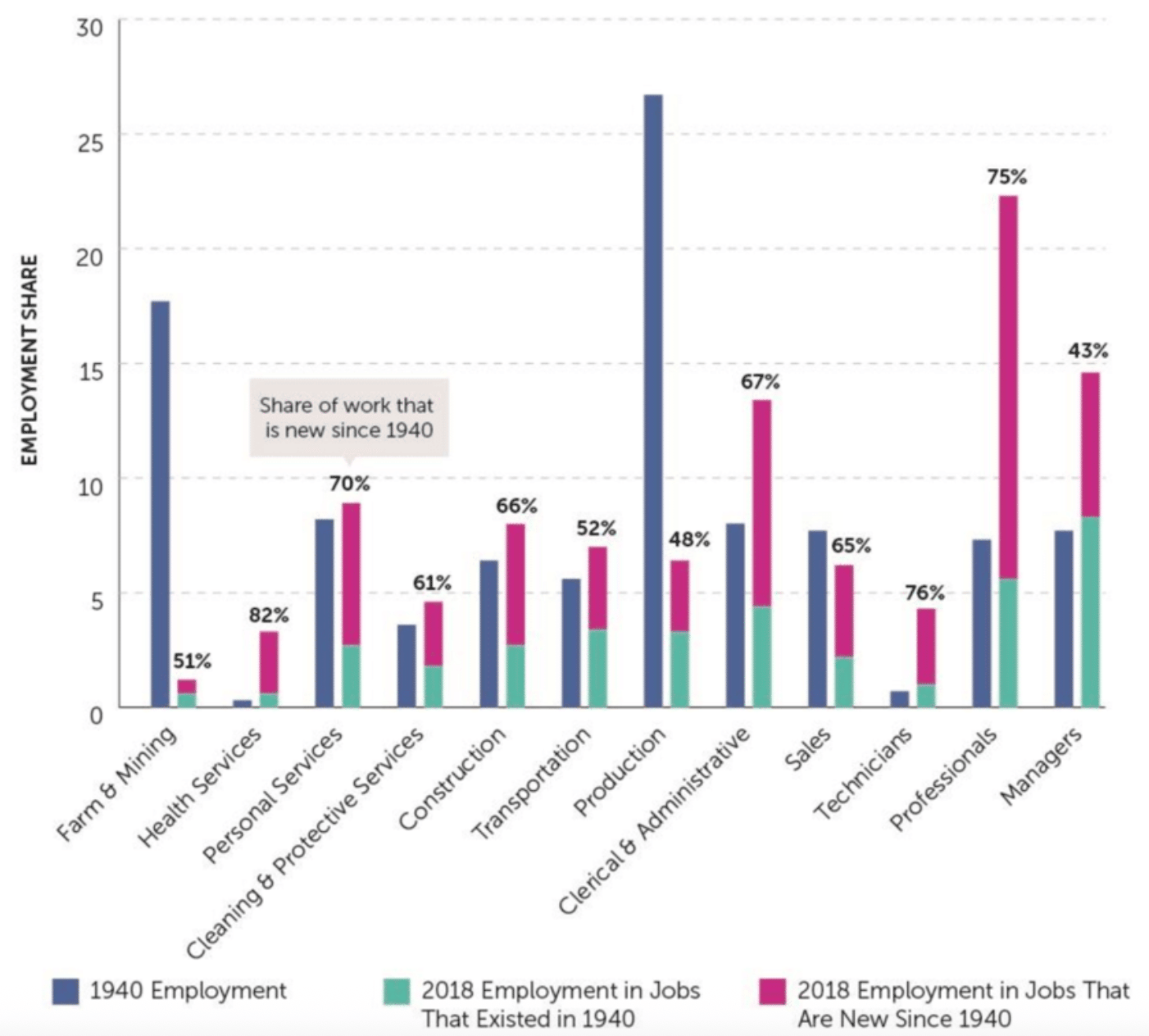
This is not our first rodeo but the tempo is faster. Roughly 60% of US workers in 2018 were in occupations that didn’t exist in 1940. New work is the primary source of long-run employment growth [MIT, Autor et al., Researchgate 2022].
Most companies need to reorganise to AI/digitally transform including:
Regrouped and cross-functional C-Suite executives,
Fewer hierarchical layers to be more responsive,
Fewer middle managers with great spans of control [e.g. Amazon],
More rising individual contributors (getting promoted without managing),
Mapping of non-linear career options to help advance employees,
Emphasis by employers and employees on ongoing re/upskilling,
Internal marketplaces enabling matching of skills and projects,
Manager focus to identify and move people into new roles.
Work is dynamic. Skills are the unit of work. Roles are changing. Enabling talent mobility is essential since 45% of employees find internal roles hard to surface; 76% say career pathways are unclear; only 7% of organisations use AI-enabled mobility platforms [Accenture Talent Reinventors, 2025].
“18% of [global] organisations already balance AI adoption with a people-first mindset.” Accenture, Talent Reinventors: Delivering value with and for people in the age of AI, March 2026.
Major organisations are demonstrating workable options (some you have seen):
IKEA retrained ~8,500 customer-service agents as remote interior-design advisors after its chatbot took basic queries [Reuters, 2024].
AT&T’s Future Ready has reskilled 100,000+ employees with $1B+ in funding since launch [AT&T, 2023].
Schneider Electric’s Open Talent Market uses AI matching and now fills nearly 50% of open roles internally [Gloat, 2024].
Mastercard‘s Unlocked surfaces internal projects, gigs and roles in one platform; most senior roles are filled internally [Mastercard, 2024].
Bank of America’s The Academy has reskilled 30,000+employees over the last several years [BofA, 2024].
The compelling evidence you need to convince your executive team and Board:
The 18% of firms acting as Talent Reinventors grew revenue 1.8 pts and profit 1.4 pts higher than peers in 2025, and were 7x more likely to strengthen organisational culture [Accenture, 2025].
How can AI augment your talent for long-term human-AI sustainable growth?
Augment, Elevate, Justify
The growth case for AI is now the strategically dominant answer to substitution cases. 64% of firms say AI is now enabling innovation not just efficiency [McKinsey State of AI, 2025].
Morgan Stanley augmented advisors with an internal AI assistant after rigorous quality validation reaching 98% adoption [McKinsey, 2025].
Mercedes-Benz is augmenting line workers with AI vision systems and reporting double-digit quality gains [Mercedes-Benz, 2025].
Klarna switched to an AI agent, firing employees, then rehired people when experience and complex queries collapsed [DigitalApplied, 2025].
Internal strategies are best complemented by societal support. Government regulation and enforcement can play a role in prompting executives to take longer-term, more human-centric actions and reconfigure strategies.
In China, the government took notable action in two cases since late 2025. Beijing’s Municipal Bureau of Human Resources and Social Security ruled that AI replacing a worker’s role does not by itself justify dismissal under China’s Labor Contract Law. The arbitration committee called it “shifting the risk of technological iteration to the employee” [CGTN, Dec 2025]. A Hangzhou court delivered a similar ruling in early 2026 [SCIO, Apr 2026].
The UK and EU have AI-related regulations, the US is an evolving complex patchwork. However, the action that matters right now is at your company, among your leaders, to refine an AI transformation strategy - embodying the values your customers and employees believe in - that will allow your business to compete AND build towards a future you can justify to future generations.
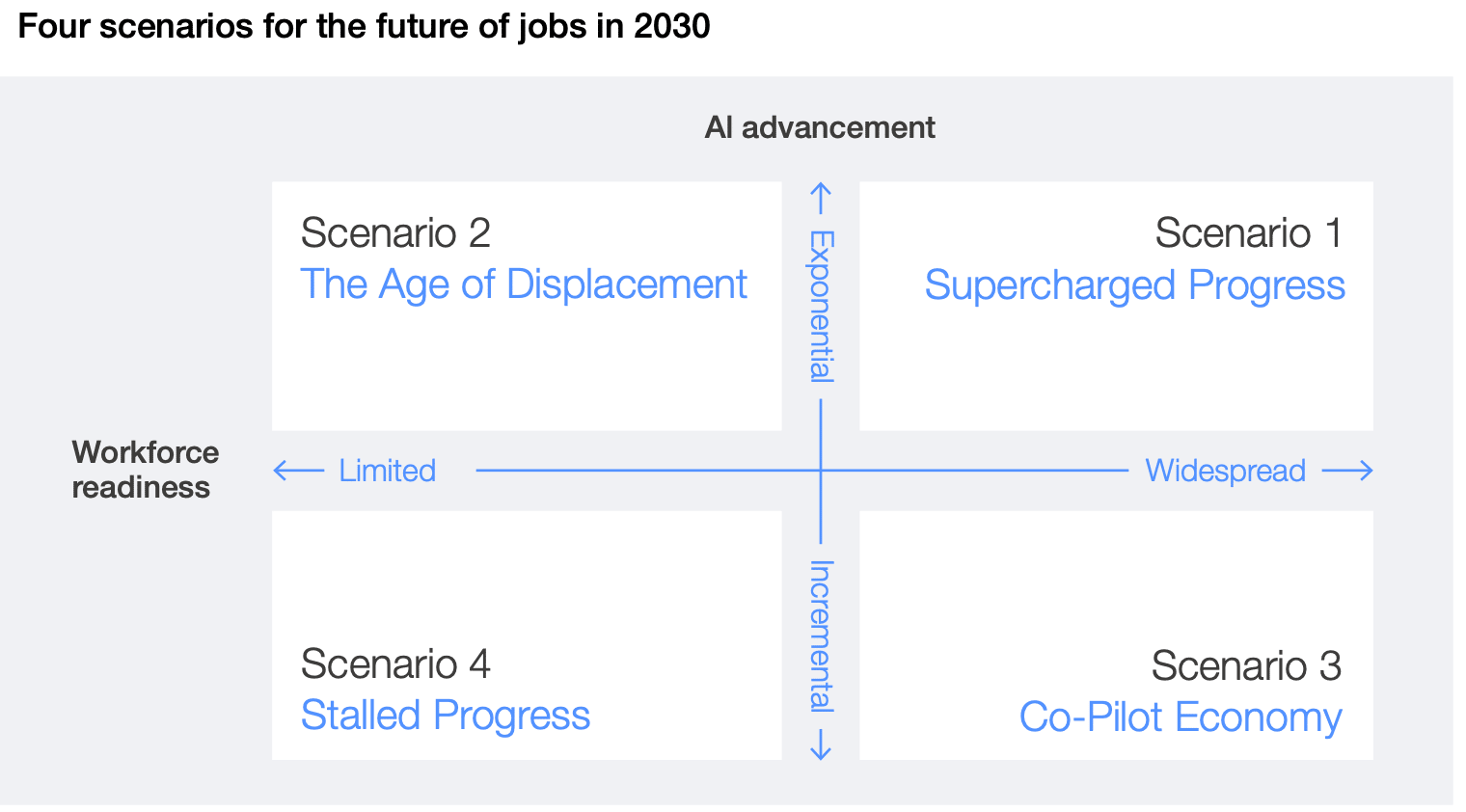
“The future of workplaces and value chains will not be defined by the technologies alone. Human capital strategies and investments prioritized today will determine how well societies and individual businesses can adapt to–and lead in–the new economy.” WEF, Four Futures for Jobs in the New Economy: AI and Talent in 2030, Jan 2026.
Review WEF’s four scenarios below. Your company can purposefully develop a “no-regret” strategy for your business to compete successfully including:
Anticipate talent needs and future-proof value chains.
Align technology and talent strategies.
Invest in human-AI collaboration and agentic workflows.
Strengthen organisational culture and trust in emerging technologies.
Design multigenerational workflows [WEF, Four Futures, 2026].
73% of Gen Zs and 70% of Millennials say they are actively monitoring AI’s impact on their own jobs over the next year [Deloitte, 2024]. To build trust, be more transparent, reduce fear, and increase productive engagement with AI:
Help young employees reskill, upskill and move within your organisation.
Develop apprenticeships for new graduates to learn on the job.
Encourage self-directed skills development (with yearly stipend?).
Cultivate confidence in mobility and show talent redeployments.
Build trust as a foundational cultural value and in AI deployment.
Create a governance framework with awareness and engagement at the frontline and middle management to ensure full participation.
((Personal note: a 12-year old relative of mine told me they had researched what jobs might be risk-free for their future - dental hygenist was one option)).
Which 2030 scenario does your AI plan assume? Which is it actively building?
In Practice
RISING LEADER & INDIVIDUAL CONTRIBUTOR
Steward your options and value
Map your role into skills, not titles. Identify two adjacent areas where key skills could transfer and project where you could demonstrate value.
Treat reskilling as a daily practice. Block weekly time to develop one new AI and soft skill capability. Document how they change your results.
Build your internal network across functions. Lateral and diagonal moves are facilitated by relationships as well as internal job boards.
TEAM LEADER
Redesign roles before removing them.
Before agreeing a headcount reduction, run a redesign: which tasks shift to AI, which shift or expand for the employee, what new tasks emerge.
Protect at least one entry-level role per team as a learning system. Define what that person learns, from whom and using what tools.
Surface internal moves visibly: share lateral and diagonal team moves for over the past year. Cultivate reinvention and cross-company ties.
SENIOR LEADER
Compete on growth, not cuts.
Set an AI investment frame: what new value is being created, what capabilities are strengthened, what are realistic AI investment costs.
Fund, foster, and facilitate an internal talent marketplace where skills, projects and learning are surfaced together and matched actively.
Sponsor an apprenticeship rebuild: graduate, returner and reskill pathways with protected funding and a named owner.
Build “no-regret” strategies that work across all four WEF futures: trust, mobility, multi-generational workflows, data and AI governance.
Track who captures the gains: ensuring a combination of shareholders, workers, customers, and the broader capability base.
News & Muse
📹 We Studied 150 Developers Using AI - here’s what actually changed.
📘 Nexus, Yuval Harari — thinking about where we are and what’s next.
🗞️ The Fearless Future, PwC’s case for AI as a growth, not headcount, strategy.
🎶 Teach Your Children, CSNY- what are your kids learning by your example?
AI is becoming a generation-defining choice about human work and skills, and how dynamic or brittle the labour market is for our children. For your firm to succeed, you must compete on growth, mobility and capability.
Protect entry points. Facilitate internal pathways. Augment, don’t substitute. Play the longer game. Build a future worth competing for.
See you next week.
Sophie
This resonates with what I see in workshops every week. 70% of AI initiatives stall on people issues, not technology. And yet that's still where the least money and time gets spent. Sharp piece!