

Create Human-Centric AI Culture
Nurture workspace to embrace human-AI capabilities.

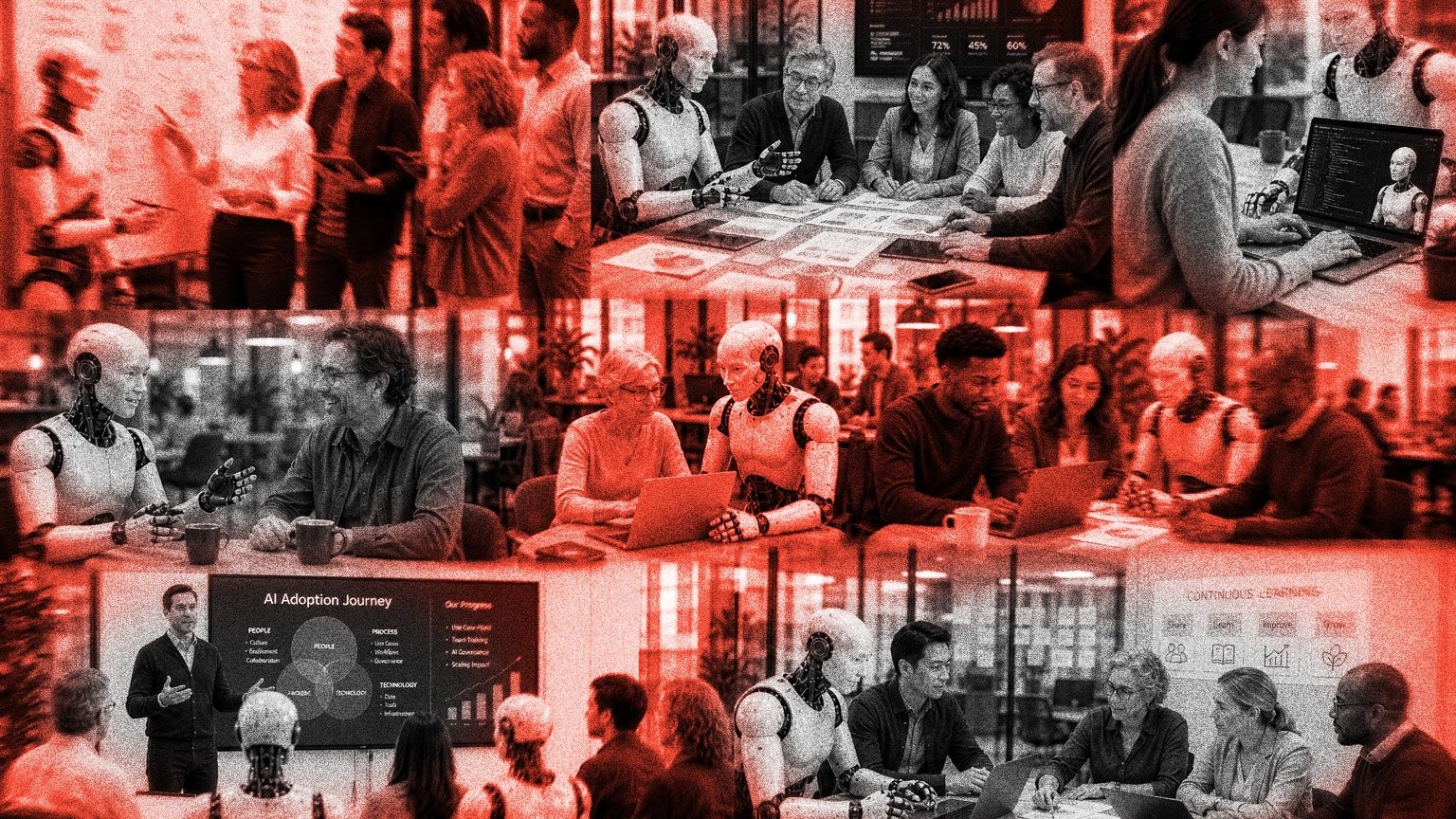
AI implementation is much more than a series of software upgrades. It’s AI (aka digital) transformation requiring a system overhaul involving changes to tech AND culture, values, experiences and practices. Digital transformations mostly failed in the 2010s as they were too tech-siloed. Achieving AI impact, expanding capabilities and capacity, requires involved managers and empowered workers collaborating as operational partners in a trusting, AI-receptive environment.
“The constraint for most firms is the gap between what their employees can now do and what their organisations are built to support.” — Microsoft 2026 Work Trend Index, May 2026.
Upskilling & Uplifting
Individual workers have mostly been surging and scrambling to upskill for AI. 67% of workers’ AI practices are now advanced or taking shape. AI is raising the bar on what people can achieve, enabling higher value cognitive work:
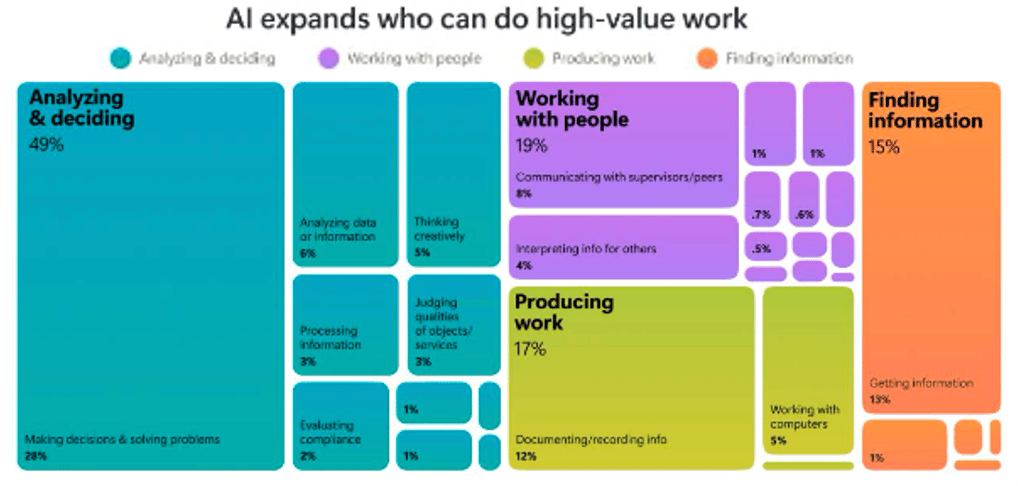
86% of AI users treat AI output as a starting point, staying responsible for the thinking and judgement.
66% say AI lets them spend more time on high-value work.
58% say they are producing work they couldn’t a year ago, and 80% of Frontier Professionals (advanced AI users) [Microsoft WTI 2026].
Where is your team capturing more value in their daily work?
Cultural Constraints
Now lingering limitations are environmental more than individual. Lack of attention to cultural aspects are constraining further capture of AI value, without human-centric leadership promoting learning and reinvention, managerial trust and support, encouragement to experiment and investment in careers. These organisational factors account for more than 2x the AI impact of individual factors such as mindset and skill (67% vs. 32%).
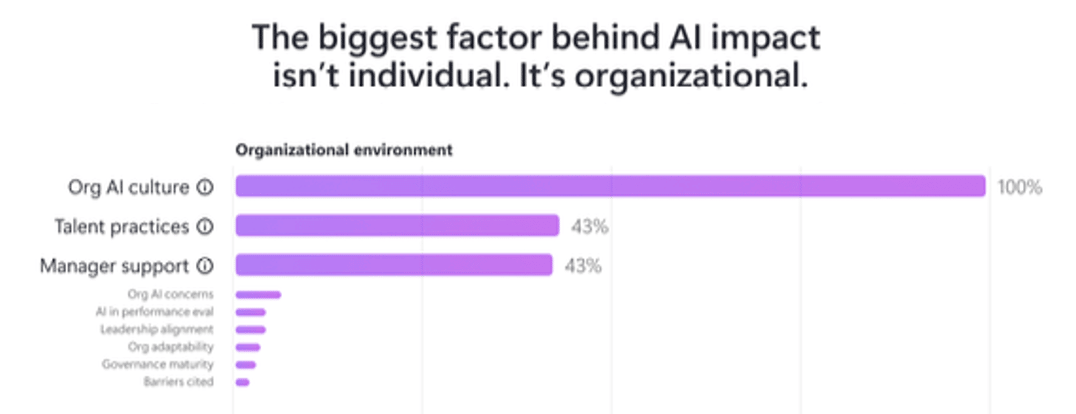
Other 2026 data confirms human-centricity must balance tech-driven efforts:
10% of AI value comes from algorithms, 20% from required technology to implement them, 70% from people-related transformation. [BCG, AI Transformation is a Workforce Transformation, Feb 2026].
~2x more likely revenue growth of 10% or more for companies investing in trust-enabling activities [McKinsey, Reconfiguring Work, Aug 2025].
59% of firms are taking a tech-focused approach to AI, and are 1.6xLESS likely to realise returns above expectations versus those taking a human-centric approach [Deloitte, 2026 Global Human Capital Trends].
Corporate culture lays the foundation for productive operating environments. Culture grounds people during times of uncertainty, helping them stay focused and on track. Culture influences how leaders and employees think and act, especially when exploring and expanding use of powerful new capabilities.
“Value doesn’t just come from the technology but from how they empower their people to capitalize on it.” — BCG, 2026.
Trust is a core value expressed through cultural tenets and behaviours. Employees may hold back if they don’t trust their leaders or managers. They might be concerned how AI may affect their working lives. Or they don’t feel empowered to experiment. Or they aren’t sure what is allowed. Or they aren’t clear how much they can have confidence in the quality of LLMs’ answers. Improve a low-trust environment and the results speak for themselves:
Collaborative learning reached 60% from 36%, AI use rose to 71% from 36% with clear guardrails with a culture of curiosity, leadership engagement, and an ambassador network [Deloitte re Save the Children]
98% adoption of Morgan Stanley’s AI assistant across wealth management teams once rigorous evaluation frameworks proved AI answers met advisor quality standards [McKinsey, Reconfiguring Work].
Are you nurturing a culture that helps realise benefits of your AI investments?
Managers’ Momentum
As culture creates the space and sets the stage, managers direct the actors — confirming daily practices and behaviours as their spans of control expand. Managers are responsible for cultivating safe space for experimentation, while clarifying what AI actions are secure and reminding people where the limits are. They set important examples generating (or decreasing) momentum of AI use:
Managers modelling AI use: employees cite 17 pt uplift in AI value, 22 ptuplift in critical thinking using AI, and a +30 pt lift in trust in agentic AI.
Managers fostering psychological safety in experimentation: employees report 20 pt uplift in AI readiness and value, 1.4x greater likelihood to be high-frequency users of agentic AI [Microsoft, 2026 WTI].
Managers supporting AI use: employees are 1.7x more likely to use AI weekly, 7.4x more likely to say AI helps them do what they do best, and 8.7x more likely to say AI has transformed work design [Gallup, 2026].
88% of managers at ‘future-built’ companies role-model AI in decisions and daily operations compared to 25% at laggard firms [BCG, 2026].
Encourage managers to use AI openly, visibly set quality standards, incentivise trials to redesign work, and not punish good faith attempts. Frontier Professionals are more likely than other AI users to say their manager:
Openly uses AI (85% vs. 64%)
Creates space for experimentation (84% vs. 61%)
Encourages ambitious work redesign (87% vs. 61%)
Rewards reinvention regardless of result (26% vs. 11%) [2026 WTI].
This isn’t most workers’ current reality. Only 21% of employees strongly agree their manager actively supports their team’s AI use [Gallup AI Indicator 2026]. Managers need to encourage and expand their teams’ AI use. Hold them accountable for empowering their teams to reinvent work as they implement AI.
How are managers modelling AI? Are they rewarding reinvention of work?
Systemic Reinvention
‘Using’ AI produces limited benefits. Those benefits multiple when work is broken down into tasks to re/assign thoughtfully for humans and AI, reinventing processes system-wide. The overhaul needed to achieve beneficial gains takes attention and effort. Managers and employees receive contradictory messages:
Only 12% of employees strongly agree AI has changed how work gets done at their organisation [Gallup, 2026].
48% of US employees would use gen AI more with formal training.
45% would if it were integrated into daily workflows [McKinsey, 2025].
9% of employees are AI skilled beyond their organisation’s capabilities.
Yet 45% say it feels safer to stick to current goals than to redesign work.
Only 13% feel rewarded for reinvention [Microsoft, WTI 2026].
Consistent, aligned communication is critical with coherent messages that apply to the entire workforce - not just tech-focused folks. Technology delivers ~20% of the value of AI initiatives and the other 80% comes from redesigning work [PwC, 2026 AI Business Predictions].
Transformation is a full systems shift that requires everyone’s involvement (to some degree) as operations are reconfigured impacting each person’s work. Learning must be operationalised, systematised, and incentivised as a daily work habit, helping the reinvention of work in ways that recognise humans’ strengths and incorporating AI to expand capacity and enhance capabilities.
In tandem, without cultural cohesion and coordinated system-wide momentum, trust erodes, efforts are misaligned, fairness isn’t normalised, and employees disengage - which Deloitte calls ‘cultural debt’. Your board may track technical debt. What about cultural short-comings that diminish or erode AI’s benefits?
“Most organisations are overlooking AI’s impact on human-to-human behaviours, allowing misalignment, distrust, and unaddressed norms to accumulate as cultural debt.” — Deloitte, 2026 Global Human Capital Trends.
Articulate (identified) cultural tenets, emphasise trusting behaviours, foster safe spaces, forgive (reasonable) failure, normalise fairness standards, and assess strategically awhat/where/how AI usage will bring net gains to your business.
Are learning habits integrated in the flow of work throughout your company?
In Practice
RISING LEADER & INDIVIDUAL CONTRIBUTOR
Learn, explore, experiment.
Share one thing you tried with AI this week — what worked, what didn’t, what you would do differently. Normalise visible learning.
Before accepting an AI output for a stakeholder, name the assumption you are most relying on. Identify how you applied your judgement.
Pick one workflow you own. Break it into tasks. Redesign a portion with AI this month. Tell your manager what you changed with what results.
TEAM LEADER
Model the behaviour. Clarify the boundaries.
Set AI examples: Use AI openly in front of your team, walking through prompts, edits, and verifications.
Name guardrails clearly: Describe what is encouraged, what needs review at what stages, what is off limits. Ensure these are memorised.
Reward reinvention: Regardless of results recognise people who redesign workflows, experimentation and refinements.
Culture checks: Review each quarter where trust is strong, where it may be weak, what is undermining it, what is being left unsaid.
SENIOR LEADER
Cultivate a human-centric culture
Reinforce cultural tenets explicitly, incorporating talent-focused aspects such as nurturing trust and supporting psychological safety.
Identify, codify, and measure key managerial habits and incentives to support employees’ beneficial AI usage behaviours.
Pair each guardrail with an experiment. Show people evolving possibilities with the boundaries, encouraging their exploration.
Monitor cultural-debt indicators to track trust, psychological safety, fairness perceptions, and attrition of high-AI-fluency talent.
Invest in systemic learning with protected time, embedded coaching, federated agent-building, and co-creative learning loops.
News & Muse
📹 Microsoft 2026 Work Trend Index — newly released report.
📘 The Culture Code, Daniel Coyle.
🗞️ AI Transformation is a Workforce Transformation, BCG’s 10:20:70 formula.
🎶 Lean On Me, Bill Withers - echoing culture-based trust and safety.
AI transformation is a system-wide overhaul that requires a balance of tech and talent, where everyone is involved, using and benefiting from AI. Build a culture that is human-centric to align towards net positive AI benefits.
Equip managers to empower employees, with clear guardrails so they feel safe to explore and have autonomy to reinvent their work. Systematise learning to keep upskilling a daily dynamic that enables everyone.
See you next week.
Sophie