

Design Human-AI Co-Creativity
Sustain human critical thinking. Develop human-AI collaboration.

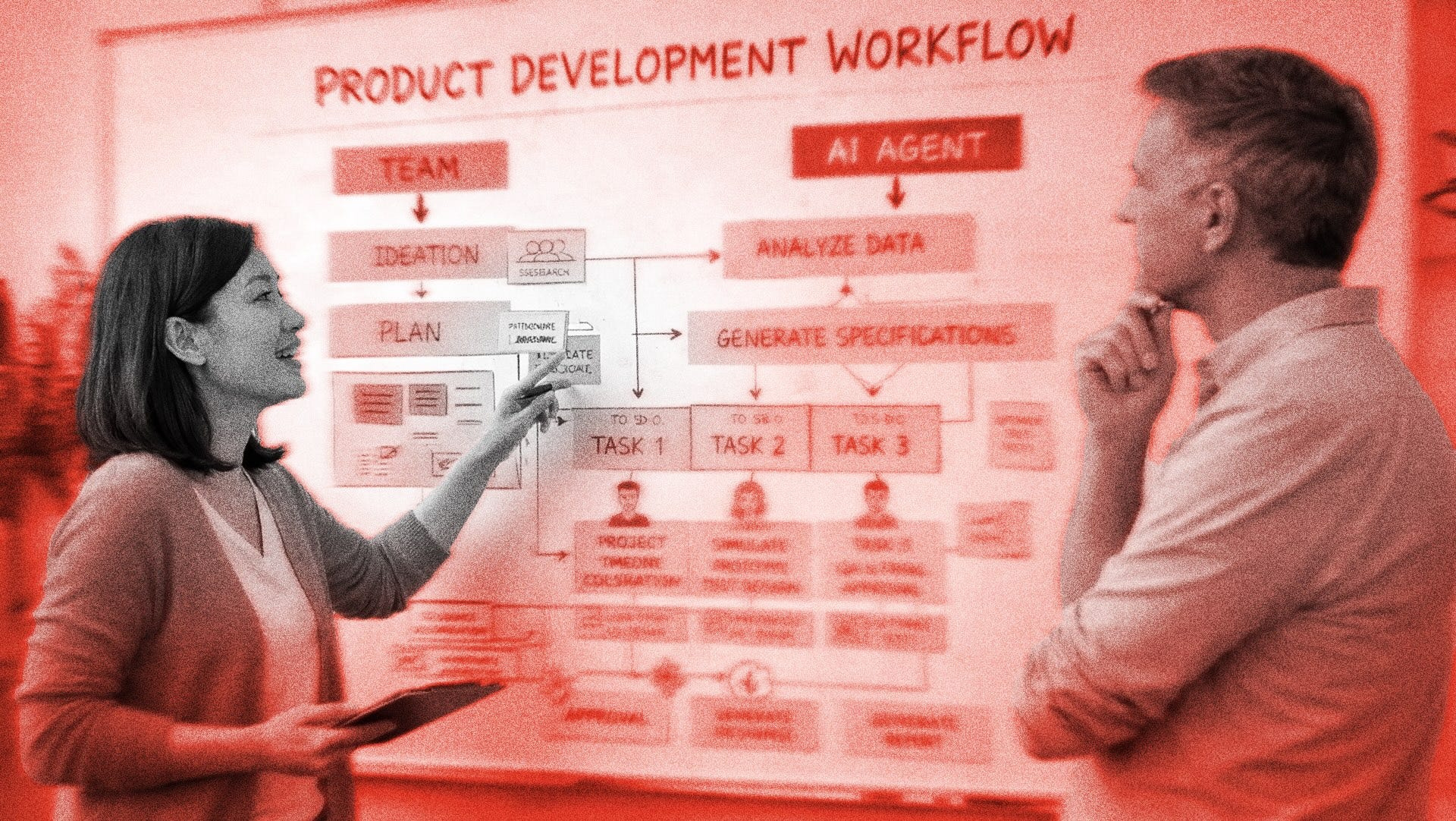
Humans and AI learn, think, and act differently. The distance may be closing, or seem to be. However, these learning and thinking differences are fundamental. Human and AI work needs to be defined and designed intentionally, distinctly, and co-creatively. Moreover, human-specific involvement is becoming more, not less, crucial, which requires cultivating particular employee skills.
“Think of AI as a scaffolding for human potential vs a substitute.”“We need to get beyond the arguments of slop vs sophistication and develop a new equilibrium in terms of our ‘theory of the mind’ that accounts for humans being equipped with these new cognitive amplifier tools as we relate to each other.” — Satya Nadella’s blog, CEO, Microsoft Dec 2025.
Knowledge Work Unknowns
Thinking critically about knowledge work is vital since practical and prolonged implications result from how you prepare for and scale AI. First raised in my Tune Up Your AI Deployment newsletter, as AI and agent utilisation proliferates, work assigned to humans and AI must be carefully understood and designed.
Start with identifying and clarifying - especially undefined - knowledge work. Humans naturally blend research, analysis, drafting, and iterative critiquing and refinements in fluid, invisible flows. Assigning work for AI automation or augmentation requires describing processes, often for the first time.
“95% of GenAI pilots had not delivered ROI,” much-quoted, is a function of “learning gaps”—people and organisations not understanding how to use AI tools or design workflows that capture AI benefits while minimising downside risks. Successful projects had technical teams with deep AI expertise collaborating closely with business stakeholders who understood operational requirements [Jeremy Kahn‘s article on Report on MIT NANDA Initiative, 2025].
“To capitalize on the promises of artificial intelligence, leaders need to deconstruct jobs and processes, redeploy work, and reconstruct new ways of operating.” — Ravin Jesuthesan article, “Want AI-Driven Productivity? Redesign Work“, MIT Sloan Management Review, 2025.
Not Fitting Flow
Humans naturally think in holistic flows. A report writer does not consciously separate “researching” from “synthesising” and “critiquing,” while agent-led workflows must be built and function with these distinctions. AI agents require discrete, granular tasks and operate through an Observe-Plan-Act-Refine cycle [Sprinklr, Agentic AI workflow] each with a distinct phase and explicit handoff.
There are “core, paradoxical tensions that define the design space of human–AI co-creativity. Without this lens, system design remains reactive, focusing on patching specific interaction failures without guiding the creation of truly synergistic co-creative environments.” — Salma, Hijón-Neira, and Pizarro, ‘Designing Co-Creative Systems: Five Paradoxes in Human–AI Collaboration‘ MDPI, October 2025.
Most of existing AI applications are linear “executors” of human instructions, at odds with humans’ natural non-linear, iterative and undefined creative flow. Working with your team, the approach must recognise and adapt optimally for these constraints - without forcing anyone to think more like a machine.
“Tool use precision is critical for successful agentic workflows. When tools are used incorrectly, consequences can cascade throughout the workflow. Effective implementation ensures proper parameter formatting, appropriate tool selection, error handling for tool failures, and clean parsing of tool outputs.“ Aisera, ‘Agentic workflows‘.
Preparation is key to successful integration, recognising the nature of AI and human learning, thinking, and working. Modern knowledge work requires workers shift from being “doers” to “thought partners” with the cognitive portion emphasised [Microsoft, “People-centric AI“ Tools for Thought” project].
Critical Trade-Offs?
Do integrated AI tools improve or reduce the creativity of results? If employees rely on AI, does it negatively impact their cognitive abilities over time? If workers are required to structure their thinking into machine-legible steps, does that reshape how they think? The answer to all these questions is: it depends.
AI boosts individual creative output but data indicates it homogenises collective output. Without deliberate design, human-AI joint creativity can stagnate rather than improve. Multiple human-AI paradoxes exist:
8.1% increase in individual novelty, 9% rise in usefulness, but stories written with AI became significantly more similar to each other. Writers “anchored” to AI suggestions, converging toward a narrower idea range.
~10% better scores for less creative workers, who benefited most individually, but there was homogenisation at a population level [Science.org, Doshi & Hauser, ‘Generative AI enhances individual creativity but reduces the collective diversity of novel content‘ 2024].
AI-assisted knowledge workflows tend to be subject to “mechanised convergence” - GenAI tools users produce less diverse sets of outcomes for the same task, compared to those without.
Workers with more confidence in AI, scrutinise it less; workers with more confidence in their own skills, perceived greater effort in assessing AI responses and using them.
Students’ results increased substantially using GPT-4. After their access ended, some students performed worse than those who never had AI.
Barriers inhibiting reflection: awareness, e.g. not recognising the need to evaluate; motivation, e.g. time pressure; and ability, e.g. lacking domain knowledge to assess correctness [ACM Digital Library, The Impact of Gen AI on Critical Thinking (survey of knowledge workers), 2025].
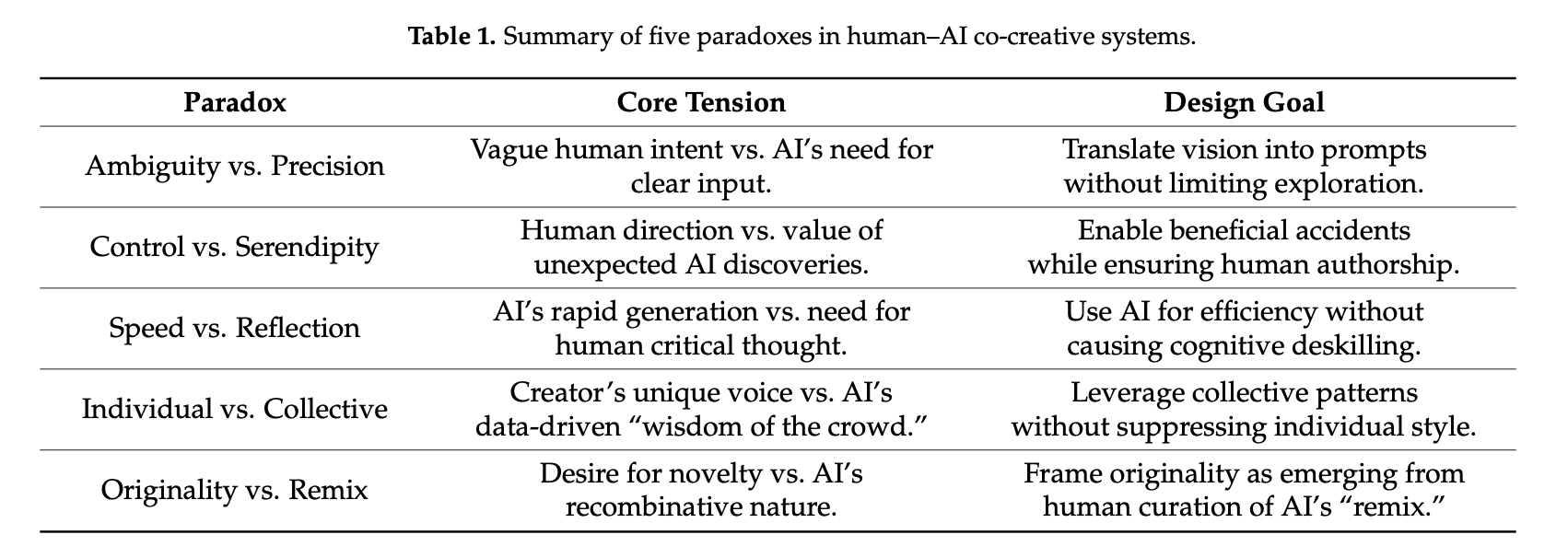
Core design tensions shape human–AI co-creative systems—ambiguity vs. precision, control vs. serendipity, speed vs. reflection, individual vs. collective, and originality vs. remix [’Designing Co-Creative Systems: Five Paradoxes in Human–AI Collaboration‘ MDPI, October 2025].
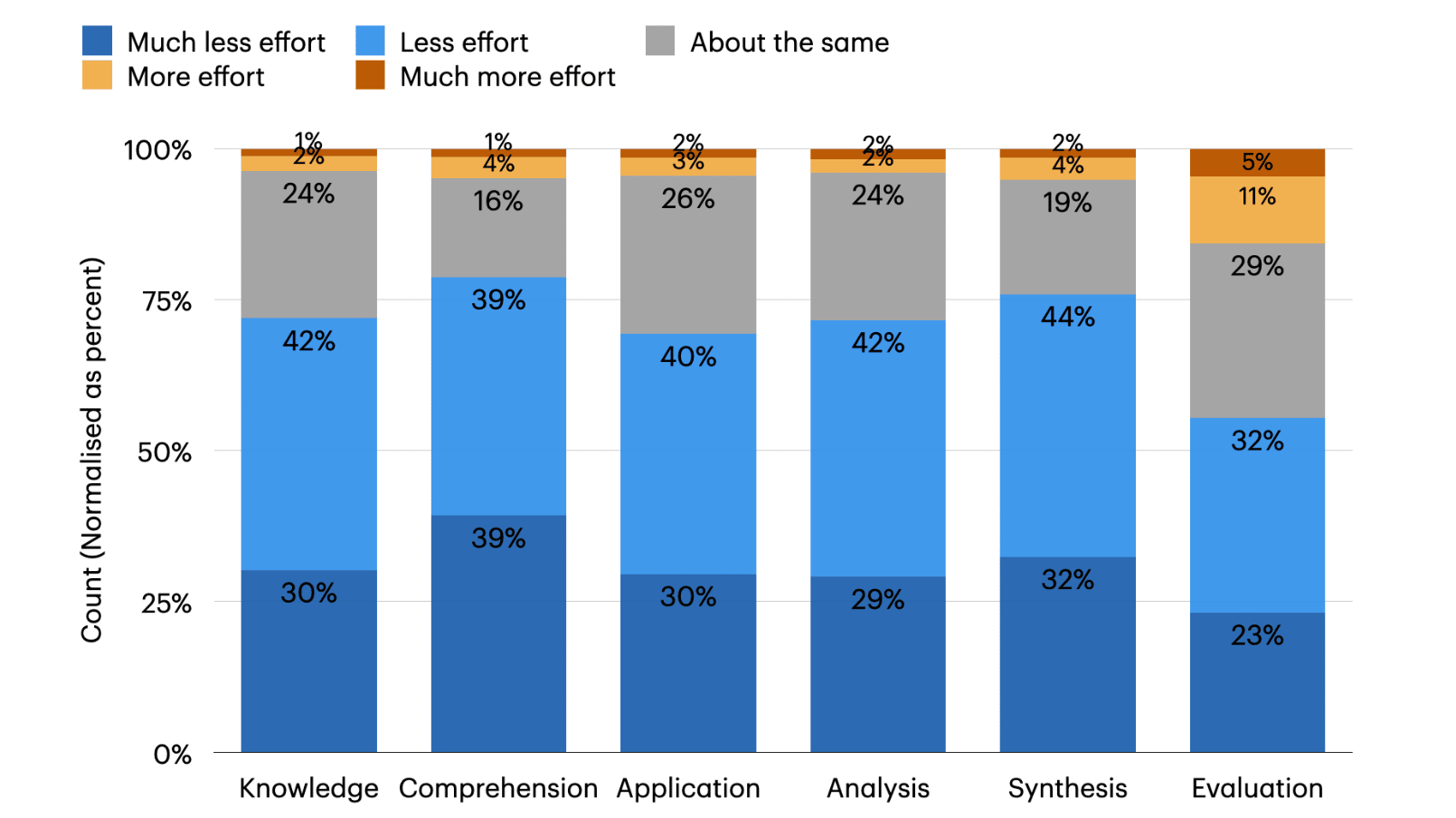
Distribution of perceived effort (%) in cognitive activities when using a GenAI tool compared to not using one:
“The problem is not whether AI is capable of contributing to creativity, but whether human–AI collaboration is designed to support it. Without deliberate structure, repeated collaboration does not automatically lead to improvement. In fact, joint creativity often stagnates over time unless organizations intervene in how humans and AI co-create.” IMD, Yeun Joon Kim, Yingyue Luna Luan‘Why human-machine teams need deliberate design to be creative.‘
How are your teams designing human-AI collaboration?
Human-AI Co-Creativity
This is Work In Progress. “Human-AI co-creation” is a new concept for AI to become an active cooperative partner. The goal of collaboration is to generate collective creativity superior to outcomes AI or humans alone could produce.
Two different approaches are outlined, one proposed in October 2025, the second earlier in February 2026. Explore what resonates with your team and company, test, tweak, and iterate.
1 - FIVE PARADOXES BASED SYSTEM
Shifts AI from being a tool to a collaborator to boost creativity, introduce new viewpoints, promote continuous learning, and solve complex issues. Five irreducible paradoxes—originality vs. remix, speed vs. reflection, control vs. serendipity, and ambiguity vs. precision—are proposed as shaping the design space for human–AI co-creative systems. These paradoxes offer a way to produce fresh design frameworks such that they are not issues to be resolved but rather necessary conflicts to be handled dynamically and cooperatively.
The concept is to rethink AI as an active, opinionated collaborator, where the human role evolves from a sole creator to a creative director who orchestrates the collaboration. As director, they provide “the vision, intentionality, and curation, while leveraging the AI’s power for exploration, variation, and pattern synthesis. The ultimate objective is to enhance human creativity by making sure AI serves as an inspiration rather than a limitation, enabling people to continue being the deliberate, creative leaders at the centre of the process.” [Read MDPI, Design Co-Creative System: Five Paradoxes in Human-AI Collaboration 2025].
2 - THREE ACTIVITIES-BASED COLLABORATION
For collaboration to be effective, humans and AI must learn about each other which occurs over time and through repeated engagements. Providing people with templates and workflows helps guide the ongoing co-creation process. For instance, managers might establish a clear sequence where AI generates, humans critique and redirect, AI refines, and humans synthesize.
Three distinct activities are found to be attuned for human-AI collaboration:
Responsive Refinement - humans generate ideas and AI provides feedback, taking advantage of AI’s ability to spot practical constraints, market parallels, or execution challenges quickly.
Generative Expansion - humans provide direction and AI generates new ideas, well suited for very specific prompts, often building on existing work, so the AI doesn’t converge on safe and practical solutions.
Bidirectional Development - both humans and AI offer improvements. Humans critique and edit/adapt AI-generated ideas, AI analyses and augments human ideas. This is requires the most deliberate structure.
Each activity requires adjusted human behaviour, such as employees offering ideas clearly enough in “Responsive refinement” for AI to give meaningful feedback. “Generative Expansion” requires attention to AI providing any ideas that converge towards standard solutions. [IMD, Yeun Joon Kim, Yingyue Luna Luan‘Why human-machine teams need deliberate design to be creative‘ 2026
“Creativity improves only when organizations actively guide human–AI collaboration toward idea co-development, emphasizing feedback exchange, iterative refinement, and the strategic adjustment of roles across co-creation activities.” IMD, Yeun Joon Kim, Yingyue Luna Luan‘Why human-machine teams need deliberate design to be creative.‘
OTHER RESEARCH TO INFORM EXPLORATION:
Art research suggests that “generative synesthesia”, harmonious blending of human exploration and AI exploitation, may discover new creative workflows [Academic.oup.com Generative artificial intelligence, human creativity, and art].
GenAI Enhances Individual Creativity but Reduces Collective Diversity
Augmented Learning for Joint Creativity in Human-GenAI Co-Creation
Not forgetting the foundation of ‘truth’. Understanding the appropriate level of accuracy is the starting platform on which any human-AI collaboration is built.
“AI is the ultimate amplifier of your data provenance… if something is incorrect at the source, gen AI is actually going to make it plausible, but it’s still going to be incorrect. So having good ground truth is so important.” Marco Argenti, CIO, Goldman Sachs.
Empathy Epoch
Whether technical systems can be ‘truly creative’ gets philosophical about “appearing vs. being” and humans abilities to experience profound emotions and practice empathy. That said, new data appears to show AI driving reorganisation around human capabilities.
The new EPOCH framework proposed by Loaiza and Rigobón “The EPOCH of AI: Human-Machine Complementarities at Work, MIT Sloan Management measures five dimensions that complement AI—the acronym stands for:
Empathy and Emotional Intelligence
Presence, Networking, and Connectedness
Opinion, Judgement, and Ethics
Creativity and Imagination
Hope, Vision, and Leadership
EPOCH scores differ by occupations. Panel A below shows the score distribution of O*NET‘s major occupational groups. Panel B shows selected occupations ranked by EPOCH score from highest (at top) to lowest.
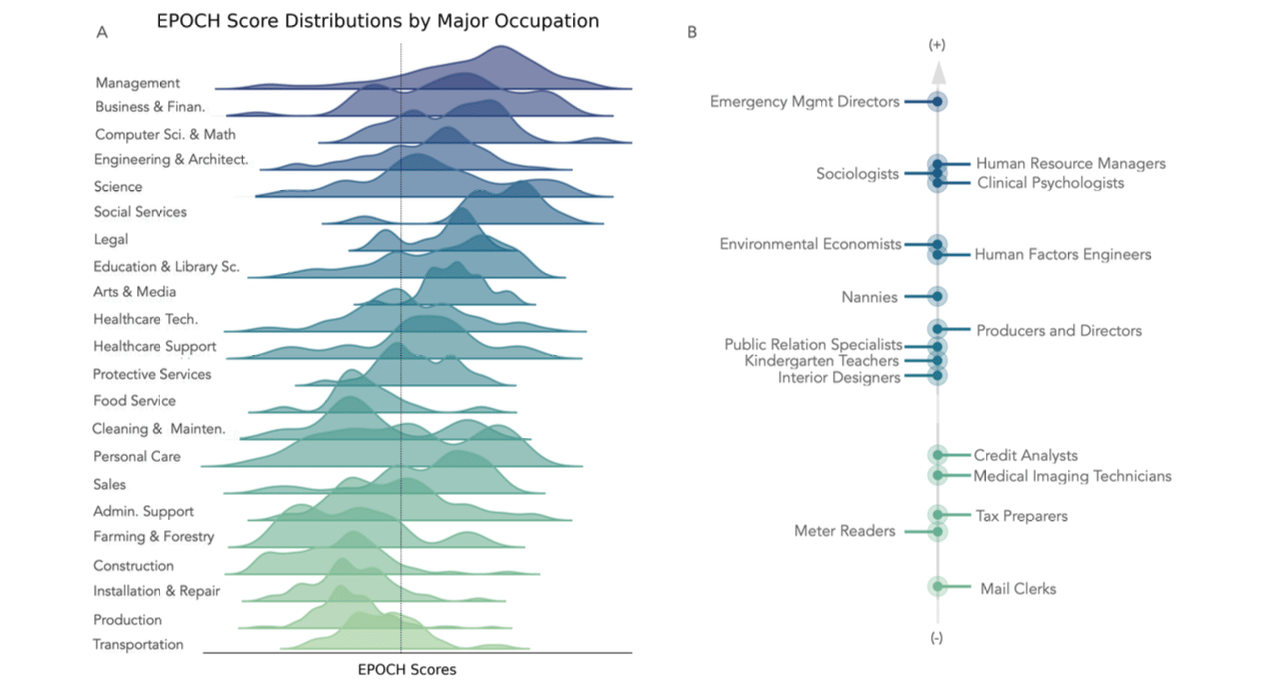
The research reveals that new workforce tasks are now significantly more human-intensive—carry much higher EPOCH scores—than existing or retired ones. EPOCH-intensive occupations also show stronger employment growth from 2015–2023 [Revelio Labs 2025] with favorable projections through 2034.
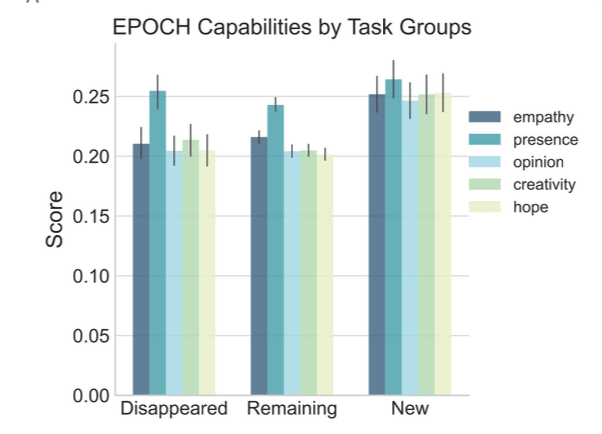
Considering EPOCH skills and resilience, having at least one capability provides protection, while multiple aspects enhance adaptability and innovation.
Revealing analysis in the same research shows five areas where AI falls short:
Small data inference - insufficient, poorly-gathered or -labeled data;
Extrapolation beyond training boundaries - with performance degrading with distance from the boundary which affects open-ended problems and flexible knowledge application;
Multiple justifiable solutions - where there are two or more valid but conflicting solutions involving ambiguity or tacit knowledge;
Relational outcomes - cases in which decision-making goals are for developing connections or sharing experiences not achieving responses;
Subjective/value-driven decisions (MIT Sloan, 2025)
How can your team’s EPOCH skills improve existing, evolving, and emerging tasks in these five areas where AI is not well-equipped?
Who is Designing How for Humans & AI?
Video platform Wistia found AI homogenising creative output used as the primary creator. Restructuring workflows, AI supports ideation and production efficiency now, while humans apply creative direction, pacing, and editorial polish. Originality is preserved with a faster overall process.
Goldman Sachs is working “to change operating processes in the firm, we’ve identified six specific processes that we’re attacking – [it] takes an enormous amount of work to bring people along” noted Solomon, CEO, January 2025.
Customer experience company, Transcom, embedded AI tools with a clear division: AI accelerates information compilation and pattern recognition, humans make decisions about customer interactions.
Siemens recognised the greatest challenges would be organisational, not technical, so the company restructured engineering teams, redesigning roles around human-AI collaboration as a core strategic principle.
Netflix clarifies how partners should best use GenAI in content production. Describing discrete sub-activities—e.g. idea generation, evaluation, and selection—with varying levels of human or AI input for each. Each sub-task is explicitly designed for the partner best suited to it.
“As AI technologies advance, human judgment remains essential in determining appropriate use and implementation. Medical educators, staff, and learners must apply their critical thinking, creativity, and adaptability to effectively integrate AI into educational practices while maintaining a human-centered approach.” Association of American Medical College (AAMC) about the role of AI in medical education.
Work is evolving fast as your teams and AI are tasked separately as well as increasingly co-creating together. Be intentional with team members about how work is designed and assigned to accelerate clarity, collaboration, and enhanced outcomes.
Developing work as it evolves requires information and attention. If your priorities could benefit from greater clarity and inputs click here to book a 45-minute session.
Next issue, empathy gets new emphasis!
See you next week.
Sophie