

Integrate AI with Empathy
Empathy is essential to achieve human-AI potential.


AI (prev. digital) transformation requires coordinated technology overhaul with organisation-wide workforce buy in and cooperation. To scale after initial clustered trials and adoptions, people-related issues dominate. Infuse empathy practices to connect with and allay employee concerns, better define and refine human and AI assignments, and enable coherent, pervasive AI implementation.
“Successful transformation will hinge not on the technology but on the people transformation that goes alongside it. That means the intentional and consistent use of empathy is essential.” — Christine Barton, a BCG managing director and senior partner, CEO Advisory leader N. America.
Tech Tanking Trust
Trust at work has been low for a while. Edelman’s Trust Barometer in 2025 revealed the significant portions of workers globally—especially middle and low income—who don’t trust that they will benefit from GenAI-related advantages.
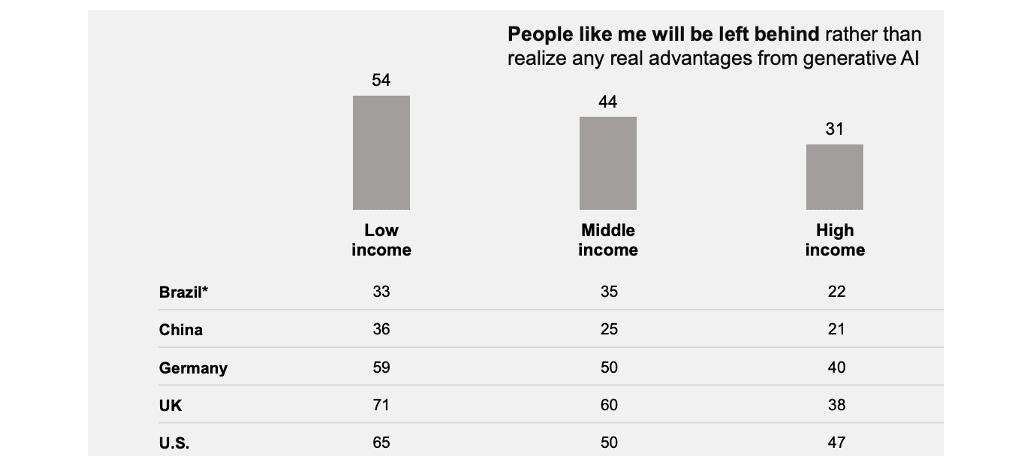
“Many people aren’t afraid of the AI tools or technology. They are afraid of being left behind or becoming irrelevant.” — Michael Ventura, author Applied Empathy.
37% of employees worldwide worry that over-reliance on AI could erode their skills and expertise [EY, Work Reimagined Survey, Q4 2025].
53% of US employees think new tech will affect job security [Mercer].
40% now worry about AI job loss, up from 28% in 2024 [Mercer 2026].
AI concerns differ by region, industry, age, and division, for example in the UK:
51% of UK workers <35 yo versus 36% >55s worry about job security.
54% of Scottish workers stress about AI-related job security compared to 47% of workers in the North, and 35% of London workers.
>50% of construction employees (the most) are worried about AI, 49%in media and marketing, and only 33% concerned in IT and telecoms.
41% of UK employees fear AI’s impact on their jobs vs. 25% of UK HR leaders [GlobalRecruiter Access Group research, Dec 2025].
Employees’ negative sentiments impact engagement, performance, and ROI. Meanwhile, these employees are directed or mandated to integrate the very technologies they expect to displace them or at least undermine their capabilities—often without leaders give them a coherent AI strategy or training.
Stalling, Straining, Training
Is AI reticence stalling usage? Gallup data for 2025 Q3 and Q4 figures look similar with organisational adoption not changing much in the US. Only 38% of US employees report their company has integrated AI to improve productivity, efficiency and quality, while 41% say AI tools have not been implemented.
The US sector-specific adoption differs: Manufacturing and healthcare reached 41% total AI users; retail 33%; education 56-63%; professional services 62%; and technology 77%; with many sectors levelling out Q4.
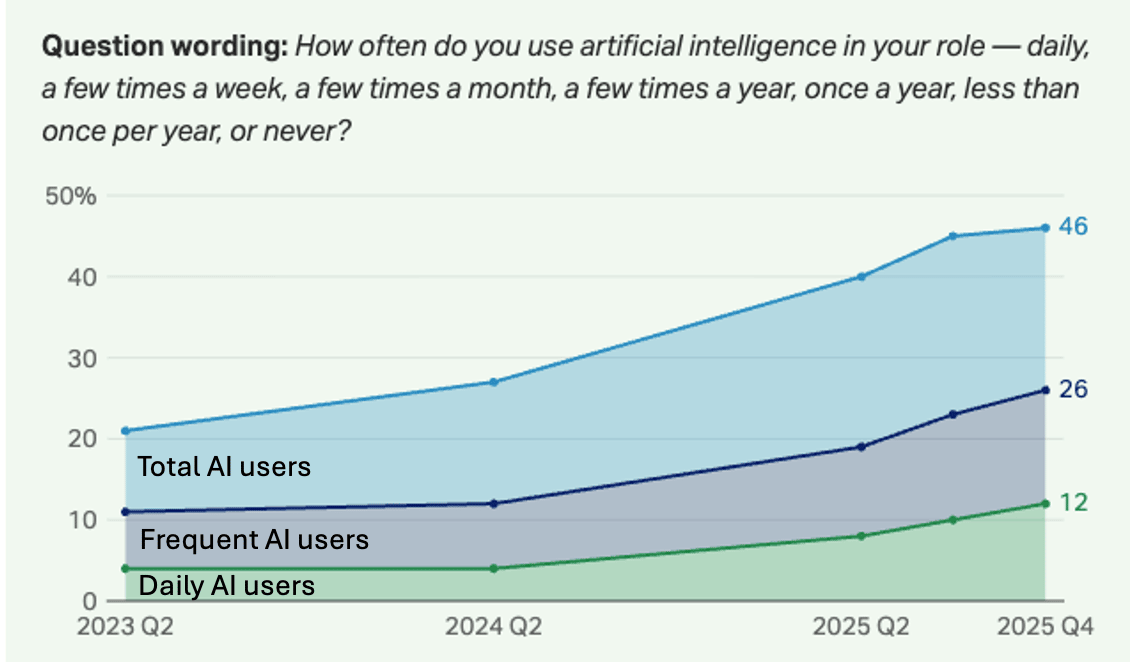
Lack of confidence and AI fluency undermine achievement of desired benefits and productivity (including ROI) goals. Unknowns and lack of training amplify employee fears and inevitably exacerbate negative potential outcomes:
17% of UK adults say they can explain AI in detail [UK Govt 2024-26].
19% of UK employees have had formal training how to use AI tools or manage them responsibly [The Access Group/YouGov, Dec 2025].
Only 52% of UK employees have had any AI training [CIPD, 2025].
33% of US employees reported getting AI training from their employer.
48% reported their company’s AI rules were mostly clear, slightly clear or not clear at all [Study.com US survey Dec, 2025]
Other concerning gaps show up in employers rating employees’ competencies in key AI skills higher than their employees do - whether these discrepancies result in AI over reliance, incorrect decisions, AI slop, or less training offered:
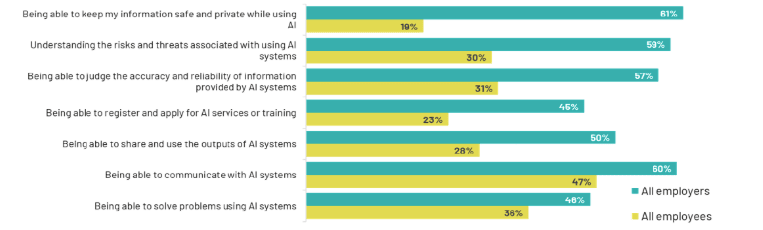
If workers don’t trust their leaders or tools and fear negative outcomes, what portion will/can do their best to realise the most effective AI implementation? Without other data, direction or support, employees’ logical assumptions are that the greater productivity gains they achieve, the faster they lose their jobs. Why engage if part of the business case ROI appears to be self-destructive?
Perhaps those very confident in their skills are optimising AI usage. Currently, only 5% globally are maximising AI to transform their work [EY, Q4 2025].
“We really need to redefine how we work. When you are going to adopt new workers into your workforce, you need to rethink how the team is going to play together to do the same tasks.”“If the person is open to AI, embraces it, goes with it, it will work.” — Roy Jakobs, CEO, Royal Philips at WEF Davos, January 2026.
Is your team confident about AI or responding to their survival instincts?
Cues, Concerns & Curiosity
Employers are missing cues and not connecting with employees’ lived experiences with AI or rising concerns about the affect on their working lives. These factors undermine psychological safety, trust, and engagement:
Only 21% of UK workers feel confident using AI [UK Govt 2024-26].
Only 14% found their AI training to be high effective.
44% of UK employees felt their organisations were ready to adopt AI yet 88% of HR leaders expressed confidence in their team’s preparedness [Corndel, 2025 Workplace Training Report].
22 million lost days in the UK from stress, depression, and anxiety, with 23 days on average for each person suffering [UK Govt. HSE, 2024/25]
Meanwhile, many employees are curious and taking action themselves:
79% of US employees report AI having some impact on their role.
22% of Gen Z have changed jobs for AI-related opportunities.
78% have switched jobs or would consider switching for better AI exposure and training [4 Corner Resources, survey Q4 2025].
46% of US employees first learned AI self-teaching or trial and error.
28% have pursued training on their own.
70% are curious, want to learn more, or feel excited because AI helps them work better [Study.com Dec 2025].
“Employees are asking how those changes will happen, what support they’ll receive, and who will help them adapt,” “Workers are eager and ambitious, already experimenting with AI tools and upskilling in their spare time, in spite of a lack of company support. They’re adapting. The real question is whether businesses will lead.” — Hannah Walton, GM/CPO/SVP, Product Mgt & Engineering, Access People.
We have been here before. Improve your odds learning from the first major digital transformation efforts in 2015-2017 of which 70%+ were unsuccessful.
Why? In BCG’s 2020 report called ‘Flipping the Odds of Digital Transformation Success,’ they highlight “The technology is important, but the people dimension is usually the determining factor.” The people dimension covers organisation, operating model, processes and culture with organisational inertia based on long-entrenched behaviours being a significant issue.
When you expand your focus beyond ROI to recognise the human impact, you can bring people along by providing more clarity, fostering employees’ curiosity, and increase their confidence through greater transparency and AI upskilling.
Skills to Stress
Modern work is more tech-based and more talent-driven. “Soft” skill intensive occupations are projected account for two-thirds of all jobs by 2030, growing at 2.5 times the rate of jobs in other occupations [Deloitte Access Economics]. These skills include communication, collaboration, empathy, and adaptability.
Below graphic shows the physical, non-physical AND social and emotional capabilities required in several occupation groups [McKinsey, Nov 2025]:
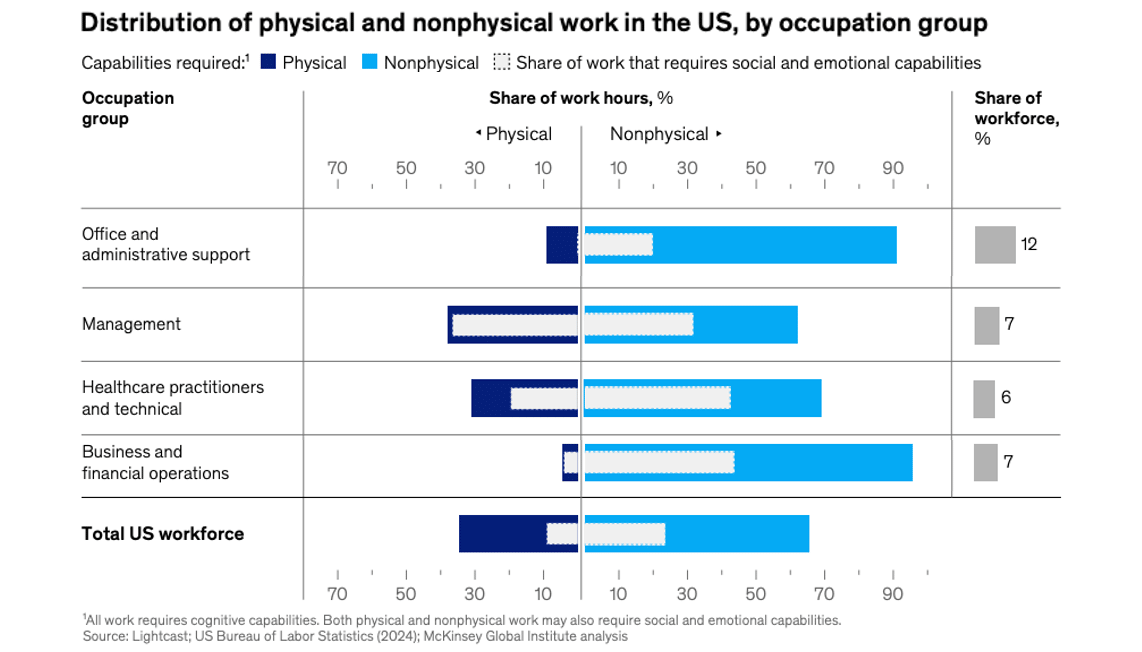
Human capabilities required for all jobs are expected to shift as AI tools and agents are utilised more. Core human skills such as problem framing, judgement, leadership and social influence, setting limits, resilience, and conflict interventions are become increasingly important in human-AI teams.
New workforce tasks are more human-intensive—carry much higher EPOCH scores—than existing or retired ones recent research reveals. Elevating the EPOCH framework shared in my last newsletter from MIT Sloan Mgt’s Loaiza, Rigobón “The EPOCH of AI: Human-Machine Complementarities at Work.”
The five E.P.O.C.H. dimensions that complement AI are: Empathy and Emotional Intelligence; Presence, Networking, and Connectedness; Opinion, Judgement, and Ethics; Creativity and Imagination; and Hope, Vision, and Leadership.
EPOCH-intensive occupations also show stronger employment growth from 2015–2023 [Revelio Labs 2025] with favourable projections through 2034.
Embracing Empathy
Empathy has three parts:
Cognitive Empathy - putting yourself in another person’s shoes as them (not you) to see the world as they do;
Affective Empathy - tuning into their feelings to connect better with their experience; and
Empathetic Action - acting based on the additional information.
Empathy is about human understanding. It is not being kind or nice (although that usually a more viable, long-term strategy!).
Find out what your team needs to help them embrace AI, achieve balanced human-AI teams, integrate appropriate tools effectively and produce the best outcomes. For example, workers prioritise transparency and oversight when asked how they could gain more confidence about AI in the workplace:
54% want the right to know when AI is monitoring them.
52% want human review of significant AI-driven decisions.
50% want the right to challenge AI decisions [Access Group research].
Empathy is a strong thread through all my work and has been for almost a decade - recognising the tech | talent balance. Empathy increases your self-awareness and awareness of other people so you can better understand your team members’ skills, strengths and stresses. Empathy informs how to best oversee employees, share more responsibility, assign which tasks to them or AI, help them orchestrate agents, and support each person individually.
Empathy’s basic pillars include:
Listening to others - actively, lean in!;
Confirming you understood - what they meant, not what you heard;
Showing you trust them by sharing more information - not everything!;
Respecting people’s opinions - without having to agree; and
Taking others’ concerns/ideas/opinions into account - not necessarily 100%, but including some recognition of their different POV.
Empathy enables you to bridge generational gaps, communicate effectively (so words land with a particular audience), understand where team members excel and what engages them. Empathy enables you to identify how each person adapts to more accountability and what they need from you to transition well.
NOTE: AI can help identify cues so you can act with empathy, e.g. noticing facial expressions or body language, changes in communication or grammar. However, you must learn empathy yourself. It is a core competency for success.
News & Muse
📹 How Empathy and AI Together Will Redefine the Future of Work
📘 Empathy Works: The Key to Competitive Advantage in the New Era of Work
🗞️ The economics of empathy: why human connection is the future of business
🎶 Deeper Understanding, Kate Bush - more, intentional, human connection.
Empathy is a core component of your evolving human-AI system. Bring the empathy you practice in your personal life into your professional life. Human-centred leadership and interactions are crucial during challenging periods of change when much is in flux. Ask more questions, listen in, share more, build trust, visibly show respect, and the results will speak volumes.
To better navigate AI implementation challenges at your company, especially employee engagement in human-AI collaboration and integration, enhance empathy skills at your company. If you would like to integrate more empathetic leadership habits, click here to book a 45-minute session, or sign your team up for my empathy-focused courses.
Next newsletter I will share examples of companies that are openly demonstrating their empathy focus.
See you next week.
Sophie