

Leapfrog Levels. Find Friction.
Upskill to advance. Up-level actively.

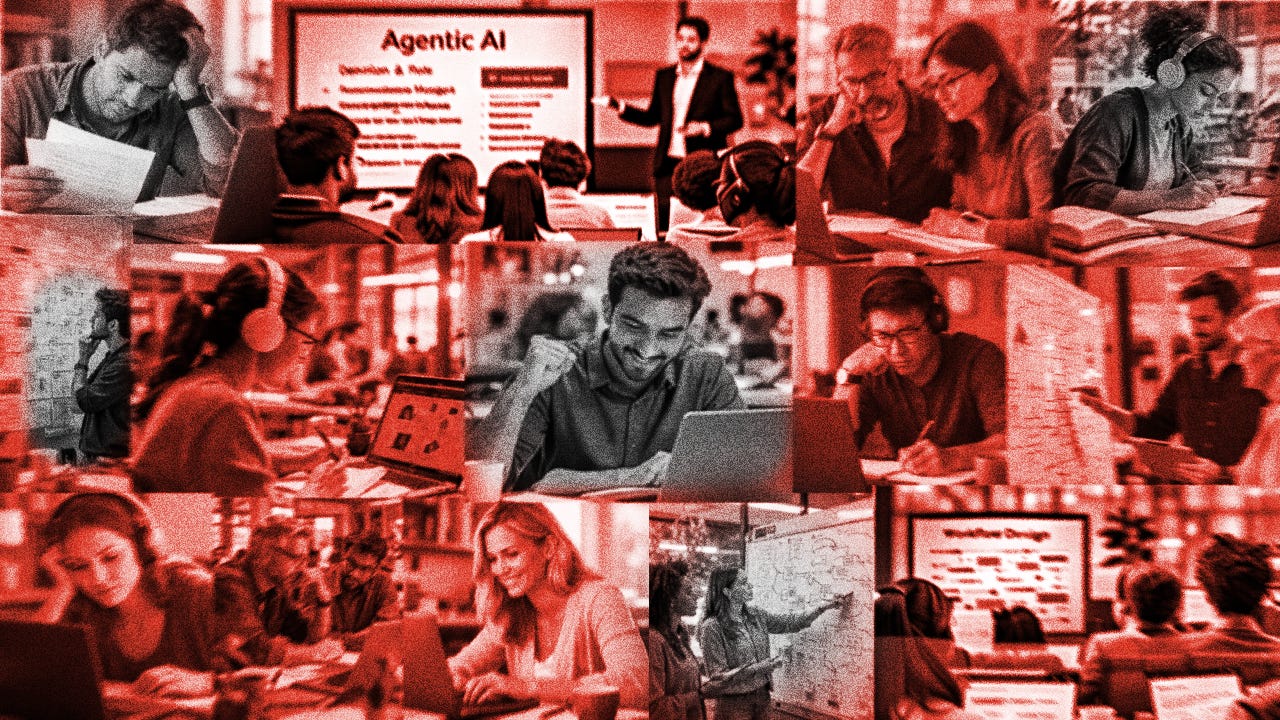
We innovate to free up capacity, build new capabilities, achieve more. We step up, not sit down, lean in, not lounge. When we attain new levels of achievement and intelligence, we reach higher, ask tougher questions, and solve harder problems. Build up to and upon the next level. Shift efficiency talk and brain rot fears to engage new capabilities, expand potential, and balance burnout.
“The best way to predict your future is to create it.” ― Peter Drucker.
Liberate not Limit
“Do more with less.” Is that sufficient for shareholders? Use more tech, need fewer people, and reduce costs? Is that a winning, long-term strategy that can enable your business to stay competitive, continue to invent better products and services, and achieve sustainable growth? Risky. That’s ‘limit-and-lose.’
Humans naturally “do more with more.” We develop advanced technologies to give workers more powerful tools, create more sophisticated offerings, serve customers better - reaching higher levels. Up-levelling means greater achievement with profits to support further investment. That’s win-win.
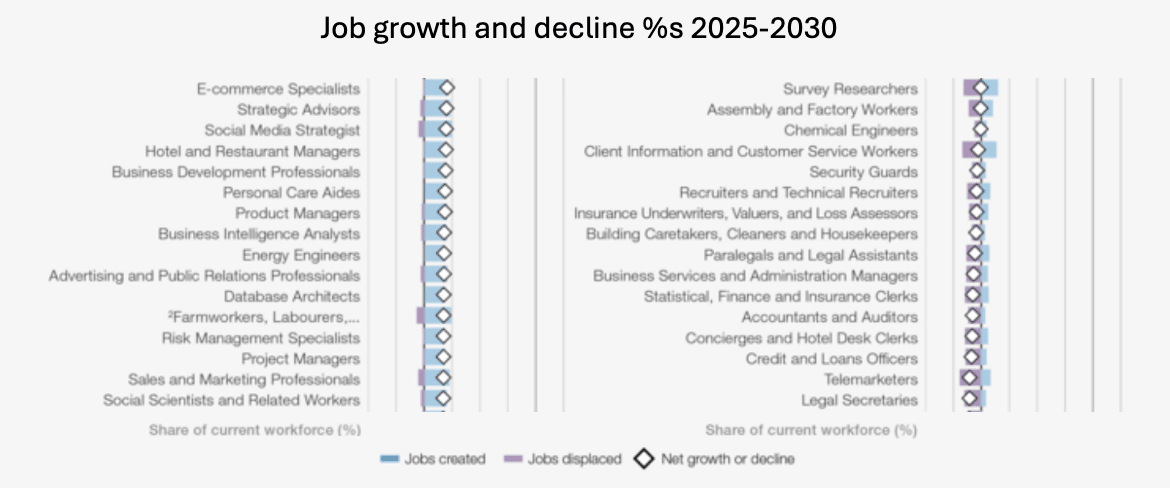
78 million job net gain globally estimated by 2030 with 170 million new roles created by 2030, against 92 million displaced [WEF].
Historically, as work got more complicated, work hours were reduced AND paid vacations introduced to balance new workloads and reduce burnout [8-hr days, 40-hr workweeks, and paid vacations mostly introduced in the early 1900s].
Now, as AI is intensifying work, we achieve more, even leapfrogging levels for different roles and tasks, and ask “Who gets the freed-up time?” Let’s ensure it’s employers AND employees. We have shared and balanced benefits before.
Are you tracking AI work intensification and burnout among your team?
Leapfrogging not Lazing
We have habitually focused on automating what was burdensome, repetitive, and error-prone (for bored humans) to ‘liberate’ capacity specifically to progress to higher order challenges. Workers advanced to next level goals—creative, innovative tasks and projects. We leapt, not lazed, with new advances.
Aggregate capabilities have risen as those benefiting from or impacted by the progress use their time elsewhere, upskilling and shifting their work to adjacent or related roles. They moved to higher level tasks, exploring new opportunities, pushing new boundaries. Consider responses to innovations such as the fridge, sawmill, tractor, calculator, laptop, blockchain, and ecommerce.
This time, AI’s direct impact on knowledge work spans technical and human skills. The breadth, depth, and especially the pace of change is preventing incremental, smoother shifts, instead requiring more intentional leaps:
39% of workers’ core skills expected to change by 2030 59% to require retraining [WEF].
815 new tasks added, 1,310 tasks retired in occupational databases 2016–2024. New tasks have higher human-complementarity scores [MIT Sloan Mgt, EPOCH framework].
Up to 12 million occupational transitions were anticipated to be needed in the US by 2030, concentrated in roles most exposed to AI [McKinsey, Generative AI and the Future of Work in America, 2023].
“Don’t be a know-it-all. Be a learn-it-all.” Satya Nadella, CEO Microsoft.
Many countries have successfully leapfrogged technology levels before. Some populations skipped the laptop era up-levelling directly to smartphones. No gradual transitions. No retraining programmes. They built natively on the mobile platform, unencumbered by legacy laptop- and web-based thinking.
In the 5 years 2012 to 2017, Myanmar went from <10% mobile penetration to achieving 100% adoption [Sumitomo].
ASEAN markets have digital payments at >50% of transaction value where credit cards often have 10-20% penetration [IMF].
These populations leapt over incremental levels with no inertia, no earlier-version constraints. They had freedom to build on what was suddenly possible. With AI-enhanced capabilities, we can leapfrog to learn at higher levels, create not crush opportunity, expand not collapse work possibilities. Upskilling to develop new potential, we can - and we must - find new focus and friction.
Research shows a direct inverse relationship between AI reliance and critical thinking engagement [n=319, Microsoft Research, “The impact of Generative AI on critical thinking“, April 2025].
48–127% improvement in practice scores with AI assistance. However, 17% worse performance by over-reliant users when access removed than for those who had never used it [Wharton, Generative AI Without Guardrails Can Harm Learning, last revised April 2026].
“If people no longer engage in effortful thinking, they lose the mental muscle needed to handle situations not found in an AI’s training data.” ― Professor Renée Richarson Gosline, MIT, Research Scientist quoted “In praise of friction“, Businessthink, Dec 2025.
We can leapfrog earlier expectations, move beyond our comfort zones, and engage our minds to exceed previous perceived limitations. The mindset for AI leapfrog is curious and constructive: “How can I enhance the business? What skills do I need and how can AI help me?” Shift the energy and conversation from anxiety to ambition. Your role is to motivate and model it.
Find New Friction
AI-based intense work doesn’t mean it’s cognitively challenging. Which is a problem. AI expands what is frictionlessly retrievable and easily achieved. But your brain’s synapses need frequent activity to keep sparking and connecting.
Cognitive offloading to AI reduces key brain activity, which means designing how you use AI to enhance your brain’s connections, not reduce them. Practice so-called ‘desirable difficulty,’ working at the edge of your current ability to push yourself, debate ideas, ask more questions, and challenge AI’s answers.
Foster friction through deliberate practice including:
Write your position first: Draft your own opinion before reading AI analysis, revealing your assumptions and sharpening your ability to evaluate what AI adds or misses, where it needs honing or redirecting.
Create options before asking: Produce your own list of options first. The discipline of developing ideas independently builds breadth and generative capacity and ensures AI doesn’t anchor your thinking first.
Argue with the output: Check details that were missed, oversimplified, approximated, or inaccurate. Build habits and muscles to assess and test AI - especially as a cognitive partner - so you can make better use of it.
Test edge cases: AI handles standard situations well. You test AI and your judgment at the edges where patterns break down and the right answer is genuinely unclear. You build your capability past AI’s reach.
How are you using generative AI to enhance your generative capabilities?
Leveling Up
Make upskilling a daily habit, part of your workflows. Whether for you or your team members, integrate practices to keep toning and building your learning muscles, more reps, more challenging cognitive loads. Where to focus first?
72% of vacancies in AI-exposed roles require management skills; over half require social-emotional or digital skills [OECD].
AI, data fluency, creative thinking, resilience, and leadership influence are the fastest-growing skills [WEF].
“People in general, and knowledge workers in particular, grow according to the demands they make on themselves.” ― Peter Drucker, management expert, from his book The Effective Executive.
Five high-value, AI-era capabilities to develop:
Judgment under uncertainty: sound decisions with incomplete evidence.
Structured problem framing: defining the most relevant question.
Verification and critical evaluation: knowing whether AI outputs are correct, close, incomplete, or incorrect.
AI fluency and workflow orchestration: recognising what to delegate, what to keep human, how to sequence.
Self-directed learning agility: identifying gaps and closing them without waiting to be told to.
Ask yourself and each team member: “What would you want to achieve if you had greater capacity, better information, or more support than you do now?”
Map, Manage, Monitor
Your development is up to you to direct. Institutional programming lags your needs. To wait would impact your cognitive abilities and career. You need to be intentional and involved. Encourage your team members to be self-directed.
AI accountability means actively deciding and evolving where AI assists or augments, what tasks/domain(s) are guarded as human (for you/your team), where you actively engage at the edge of what AI cannot yet do.
In Practice
RISING LEADER & INDIVIDUAL CONTRIBUTOR
Draw Your Map. Check Your Habits.
Identify tasks AI now handles adequately. As these become less differentiating, that’s the signal to move your energy elsewhere.
Find one thing that felt out of reach six months ago. Use AI capabilities to attempt it now. Your test is the stretch is the development.
When AI gives you an answer, ask yourself what you would have concluded without it. Explore the gap - who knew more, who was right?
TEAM LEADER
Push Productive Friction. Design for Possibility.
Replace “Which tasks can AI take over?” with “What would your work look like if repetitive tasks were handled? What would you try to build?”
Recognise and redirect negative AI practices — blocking and passive dependency. Engage with possibility, not pressure.
Design generative friction into AI use. Require reasoning alongside outputs, debate and comparison before acceptance.
SENIOR LEADER
Set the Framework. Establish New Routines.
Add expansion questions into every AI strategy conversation, such as “what can our people now do that they couldn’t before?”
Embed ongoing upskilling in the flow of work as much as possible. Periodic programmes alone can’t match the dynamism of change.
Model personal accountability. Make it visible. Sharing what you’re learning gives permission and creates mimics across the organisation.
“When you remove friction from one touchpoint, there are effects elsewhere in the system. Everything is connected. Think about a runner. Friction allows acceleration and pivot. Without it, the runner slides out of control. You can move quickly, but not strategically.” ― Professor Renée Richarson Gosline, MIT, Research Scientist.
News & Muse
📹 How to Stop AI from Killing Your Critical Thinking, Advait Sarkar.
📘 Elevate: Push Beyond Your Limits and Unlock Success, Robert Glazer.
🗞️ Making Things Hard on Yourself, But in a Good Way, Bjork & Bjork.
🎶 Move On Up, Curtis Mayfield - great vibes to help us reach higher.
To thrive in the age of AI, use it intentionally. Direct your team’s freed-up capacity towards new levels of innovation. Recognise that increased work intensity is balanced with time to decompress. Build the judgment that AI cannot replicate and design productive friction into your development and your team’s.
Upskill yourself. Uplevel your team. Find new friction.
See you next week.
Sophie