

Measure Skills and Experience
Value seasoned and recent experiences. Appreciate skills.


Experience matters. Skills matter too. Skills are becoming a new core metric of workers’ ongoing readiness and capability to contribute and scale. Balance measurements of these distinct values to adapt best at speed - whether for developing business strategies, decentralising decision-making, optimising teamwork, training talent, or reviewing CVs/resumes for hiring or promotions.
“Organisations will want to make skills the focal point for all workforce practices throughout the talent life cycle—from hiring to careers to performance management to rewards—placing more emphasis on skills and less on jobs.” — Deloitte Insights ‘Navigating the End of Jobs‘ 2023.
Switching Signals?
Strong signals of future value now are: what someone can do now, how fast they can learn, and how well their judgment transfers to changed conditions.
For decades, experience was the default proxy for capability. More years meant more prepared. Longer tenure typically meant higher level. Now, skills are increasingly important as they emerge quickly, are acquired, and expire faster.
Measuring value must balance experience with skills - from learning to usage - especially as human-AI teamwork increases. Leaders must recognise skills as a key component for assessing employees’ abilities, inputs, decision capabilities, how/where to orchestrate them, and prospects’ potential to add future value.
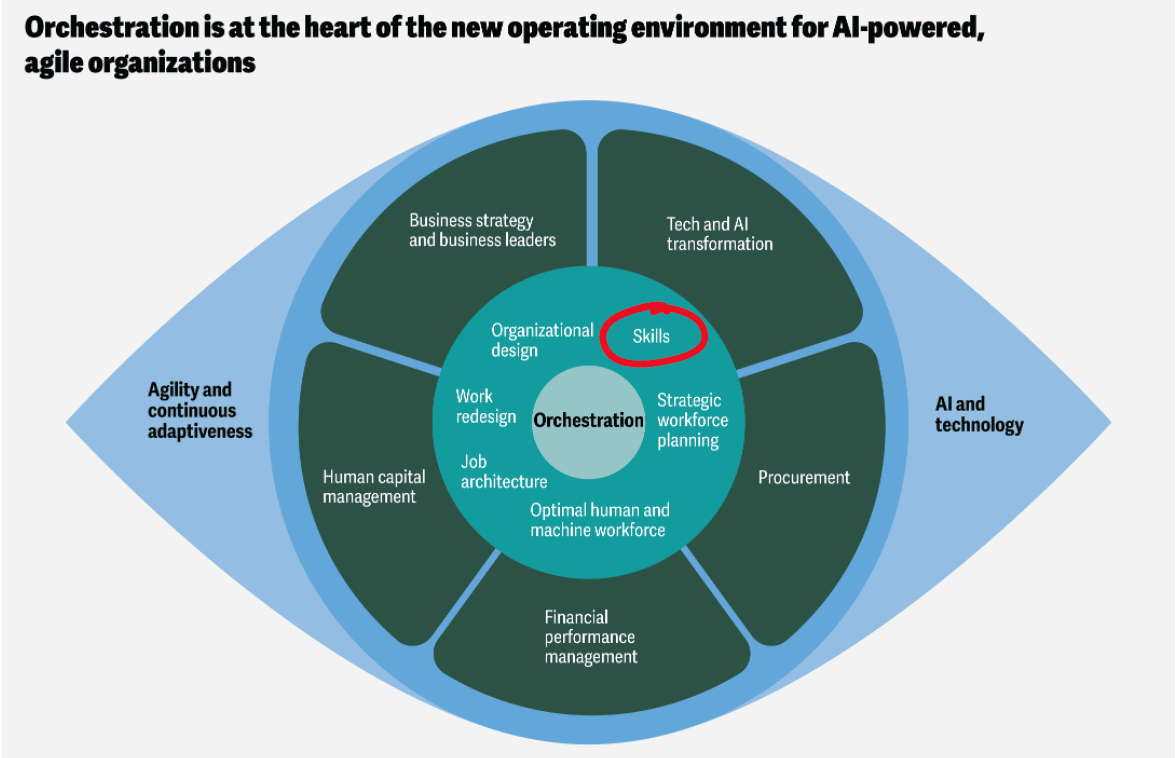
“Skills can be a very objective, quantifiable measure of capability and proficiency. We’re able to use skills data as an input into workforce planning decisions...and we align that to business strategy.” — Kate Driscoll as VP People Strategy & Operations, Cisco.
Experience Earned
Experience earns gravitas for critical understanding and processing business issues and decisions. Experience enables essential contextualisation; allows nuanced pattern recognition; includes historical data assessment to make vital judgements; and connects past and present offering grounding resilience.
Judgement is the ability to combine relevant knowledge and experience with personal qualities to form an opinion or make a decision as Andrew Likierman, Professor of Management Practice at London Business School, defines it. AI lacks consciousness, ethics, and the ability to interpret meaning, which may be nuanced, relying on context, trust, and human insights derived from experience.
“Success will depend not just on creativity and adaptability across learning contexts, but also on cultivating judgment.” — Cecilia Rouse, President, Brookings Institution.
In starkly new scenarios, recent experiences can also carry significant value. Comparing new or closely adjacent situations may be most valuable for making a decision in fast-moving operating and work conditions.
63% of executives say work falls outside formal job descriptions.
81% say work crosses functional boundaries [Deloitte, End of Jobs]
>10% of global hires, 20% of U.S. hires have job titles that did not exist in 2000 [LinkedIn, Nov 2024].
Emerging tasks are more human-intensive and composed differently from retired tasks [MIT Sloan in WIP - Design Human AI-Co-Creativity].
Valuable experience now also resides in lower hierarchies, including in new roles for which only recent experience exists.
Experiences may be compressed and need active reflection. Experience warrants nuanced understanding to deliberately realise which sources of knowledge and comparable context are relevant to apply to a current setting.
How are you valuing team members’ range of context-based experiences?
Skills Significance
Employees may feel at times they are scrambling up and across a sprawling jungle gym net of new skills as their organisation evolves and transforms. In the flow of work, they must apply newly skills quickly to adapt to changing needs and new AI versions and stay relevant to compete and grow:
66% faster changing skills for AI-exposed jobs, >2.5x faster than 2024.
56% wage premium for jobs requiring AI skills, up from 25% in 2024 [PwC, Global AI Jobs Barometer, June 2025].
83% agree AI tools support their ability to develop new skills.
30% increased focus on higher-order skills using AI to enhance productivity [Workday, Elevating Human Potential: AI Skills Revolution]
Fear of skills shortages and competition drive leaders to skills-based strategies:
47% to improve productivity and growth.
46% for greater innovation and creativity.
45% to increase agility, internal mobility [Global State of Skills 2025].
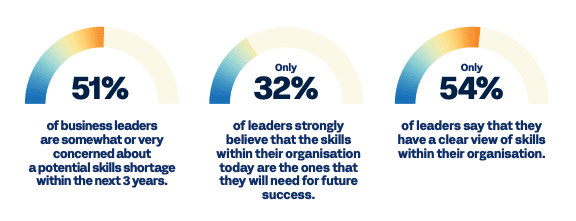
Skills are becoming a key measure of fitness for modern work, roles, and tools - from digital skills to human skills that counterbalance (often integral to employees’ ‘experience’ value, such as for judgement):
83% of workers worldwide agree that the growing use of AI will make human skills more vital.
21% think cultural sensitivity and adaptation, 20% ability to adjust to change are “most impactful skills missing from their department” [Workday, Elevating Human Potential: The AI Skills Revolution, 2025].
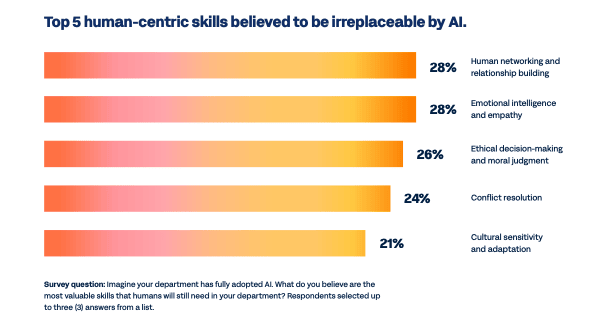
How are you developing your team’s human-centric skills?
Skills Fill Experience Gaps
Fresh graduates and early career professionals are trying hard to stretch the gap and reach up to the first ropes and rungs of organisation networks:
51% of UK entry-level jobs require an average of 2.7 years prior work experience [StandOut CV 2026].
35% of US entry-level jobs require 3+ years experience [YouTube 25].
Only 30% of 2025 grads found full-time jobs in their field by September 2025 vs. 41% in 2024 [Cengage Group, 2025 Employability Report].
What caused these huge “work experience gaps” for graduating students?
Automating away repetitive early tasks leaves more complex assignments and projects than new grads and the youngest workers were previously given. The 2+ years equate to time required doing (often ill-defined) ‘watch-me-to-learn’ apprenticeship-type work to acquire the skills to do those higher-level tasks.
This is a skills acquisition issue, not a time-based “work experience gap”.
48% of graduates feel unready to apply for entry-level jobs in their field.
56% cite job-specific skills as their biggest gap.
“The widening career readiness gap is creating an urgent need to rethink how we equip learners for future employment.” — Michael Hansen, CEO, Cengage Group.
New labour market entrants must be proactive and supported to bolster their skills to prep for the advanced lowest level work before, during and after their first job starts through a combination of:
Microcredentials offered by schools, colleges, universities etc. incl. MOOCs (Massive Open Online Courses, e.g. edX, Coursera);
Onboarding extensions with expedited, targeted upskilling;
Apprenticeship expansions for structured “learning on the job”;
Skills training offered by employers to students and new hires.
Multi-party involvement and interventions including self-directed workers, employers, and public sector policies and funding can close these gaps fastest.
Balance Experience & Skills
Skills-based hiring is already the norm and skills inventories and taxonomies are widespread now. Let’s assume you are already on the path. The goal is to shift how employees are valued and recognised in skills-integrated systems:
Define Drivers: Identify skills driving results at your company - specific technical, operational, and human skills that predict success in each critical role. Separate these from judgement-based capabilities.
Distinguish Applicability: As different signals, measure: (i) skills for current applicability and adaptability; (ii) experience for pattern recognition, decision quality, resilience, and ability to handle ambiguity; (iii) recent experience as valuable where context, tools, or market conditions have changed significantly.
Promotion & Succession Criteria: Recalibrate advancement decisions to reflect both demonstrated skills and quality of judgement gained from experience. Check experience transfers to someone’s next role and the evolving business context. Shift from assuming tenure equals readiness.
Who’s Measuring Value How?
Unilever launched an AI-powered internal talent marketplace to help employees build new skills and gain new experiences across the business.
Walmart emphasises ‘skills first’ to build careers, working to recognise people’s skills regardless of their work history or educational background. Associates can earn short-form certificates, degrees and credentials at no cost.
Rolls Royce created an Enterprise Skills Accelerator to “develop years’ worth of future-ready skill, experience and network connections in a matter of months”.
Mastercard started Unlocked as an internal opportunity network to post and find projects of interest, explore volunteer opportunities and seek out mentors by matching self-identified skills to opportunities.
“We’re beginning to think about each role at Unilever as a collection of skills, rather than simply a job title.” — Anish Singh, when CHRO, Unilever Australia and New Zealand.
News & Muse
📹 Looking for a job? Highlight your ability, not your experience, Jason Shen.
📘 The New Leadership Literacies, Bob Johansen.
🗞️ How GenAI Could Change the Value of Expertise - Fuller, Sigelman, Fenlon.
🎶 You Learn, Alanis Morissette - we’re all on the learning journey.
Audit your talent assumptions. Re-examine job requirements, CVs, internal mobility criteria, and promotion standards. Do they reflect the work ahead or still focus on past patterns? Skills and experience both matter. They need to be valued for what each contributes relevant to each situation.
Want to leap to next level leadership? Ready for focused synthesis to tackle transitional issues quicker? Let’s talk through human-AI team progress to optimise for your workforce Click here to book a 45-minute session.
See you next week.
Sophie