



Job requirements have been evolving along with the skills needed for specific tasks. Job scopes are shifting too by task - expanding and overlapping - as AI tools extend siloed disciplines’ capabilities across domain boundaries. Cross-functional work is an emergent characteristic of modern operations. Proactively identify trending task crossovers as you redesign work and reframe jobs.
Crossing Over
Job titles now approximate more than delineate what someone does. Your salespeople may be running data analysis previously done by analysts. HR managers might be drafting communications with legal weight.
Employees’ specific combinations of skills, tasks, and use of tools - matched to changing business needs - determine more the work they accomplish than their ‘job’ definition. Tasks crossing over domains is increasingly common and permanently shifted ‘job’ or work scopes are anticipated. Executives expect and encourage silos between disciplines to evolve - shifting and blurring.
“66% of C-suite leaders agree that it is very or extremely important for their organizations to push beyond the boundaries of traditional organizational functions, but only 7% are making great progress in doing so.” Deloitte 2026 Global Human Capital Trends.
The cross-functional trend started at the team (versus task) level well before the AI boom as earlier tech advances automated simple, linear work elements, leaving humans more complex non-routine projects. Responding to customers’ fast-changing demands, cross-disciplinary teams have needed to gather to rapidly develop MVP (minimum viable product) solutions.
Now, with boundary-less AI-augmented capabilities, task crossover is rising - where work typically assigned to one role is routinely appearing in the AI interactions of employees in other roles. Analysing over 800,000 work-related ChatGPT messages, 43.5% of job-specific AI use involved tasks historically associated with a different job [OpenAI, Work at the Frontier, July 2026].
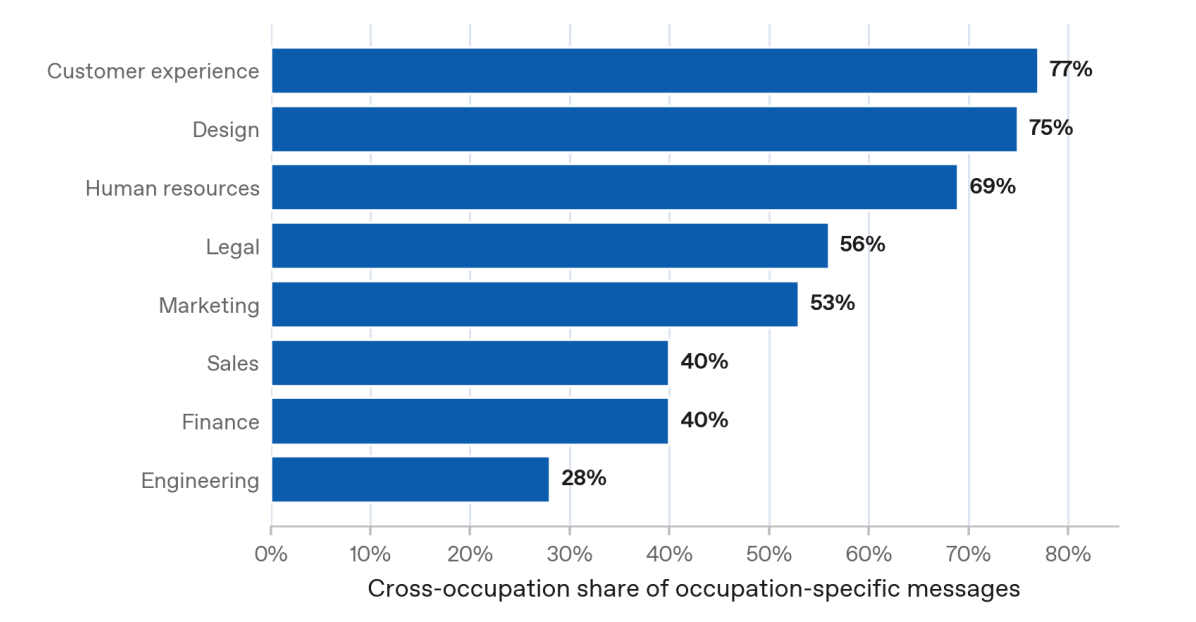
This pattern is pervasive: customer experience workers’ messages indicate their completing tasks outside their traditional role 77% of the time; designers, 75% of the time; human resources workers, 69%; legal workers, 56%; and marketers, 53%. These job scopes are operationally, yet informally, expanding and overlapping, as AI-enabled employees accomplish cross-functional work.
OpenAI’s data has captured these behaviour changes before job descriptions formally shift or specs are rewritten. Titles may adapt, or not. Usage patterns signal occupational shifts warranting attention to monitor, map and plan for.
Where are people in your organisation already overlapping into adjacent roles?
Task Evolution
Job scopes are not shifting equally. Boundaries are being breached to differing degrees depending on the discipline. OpenAI’s research reveals task crossover asymmetry which requires anticipating, planning, tracking, and coordinating.
Incoming Crossover: where other roles are taking on some of these functions’ tasks, e.g. engineering. 7.4% of messages from employees across every other occupational group involve engineering tasks - such as troubleshooting technical systems, debugging, and working with data structures. Meanwhile, only 18.5% of engineers’ messages involve tasks outside their discipline. Their job scopes are not expanding.
Outgoing Crossover: where domains draw heavily from others, while their own work stays mostly contained, e.g. design. ~35% of designers’ messages involved work outside design, while design tasks accounted for only 1.7% of messages in other fields. Designers were the most multi-domain workers.
Crossover Flow: only marketing shows much task crossover in both directions. ~24% of marketers draw work from outside their domain, while marketing tasks account for ~9% of messages from workers in other roles - the highest outward share. Jobs scopes are overlapping into and outside marketing.
In smaller organisations, crossover (18.9%) is higher in companies with 2-5 users than in those with over 100 users (16.3%). A natural explanation is that employees in smaller companies typically wear multiple hats - i.e. habitually overlap into other domains to accomplish necessary daily tasks as specialists may not be on staff or available [OpenAI, Work at the Frontier, July 2026].
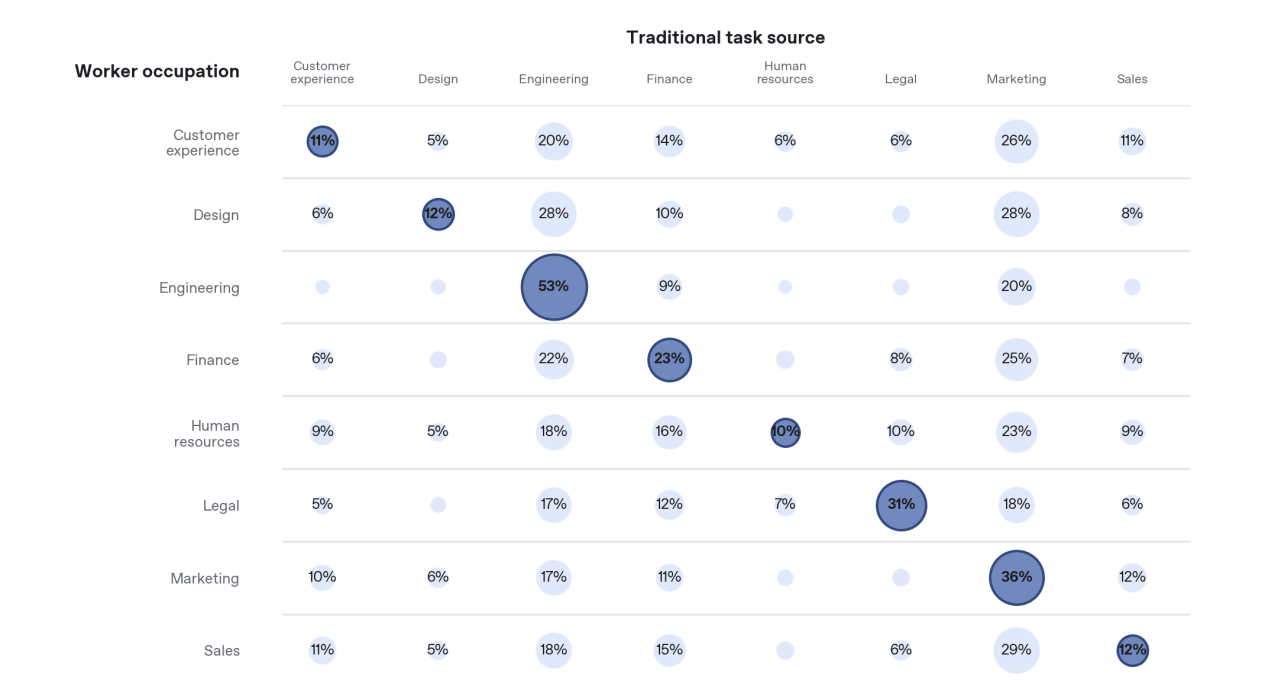
Tasks are overlapping. Some will be overtaken over time. Note: individual employees’ specific skills and AI fluency also determines their capabilities, impacting task crossover and work scope change. Overall, job specs must flex, and shift with some fluidity (for now) as tasks also change with business needs.
What tasks are your team members taking on or over from other domains?
Scope Shifting
Roles are reshaping with the impact of automation and augmentation:
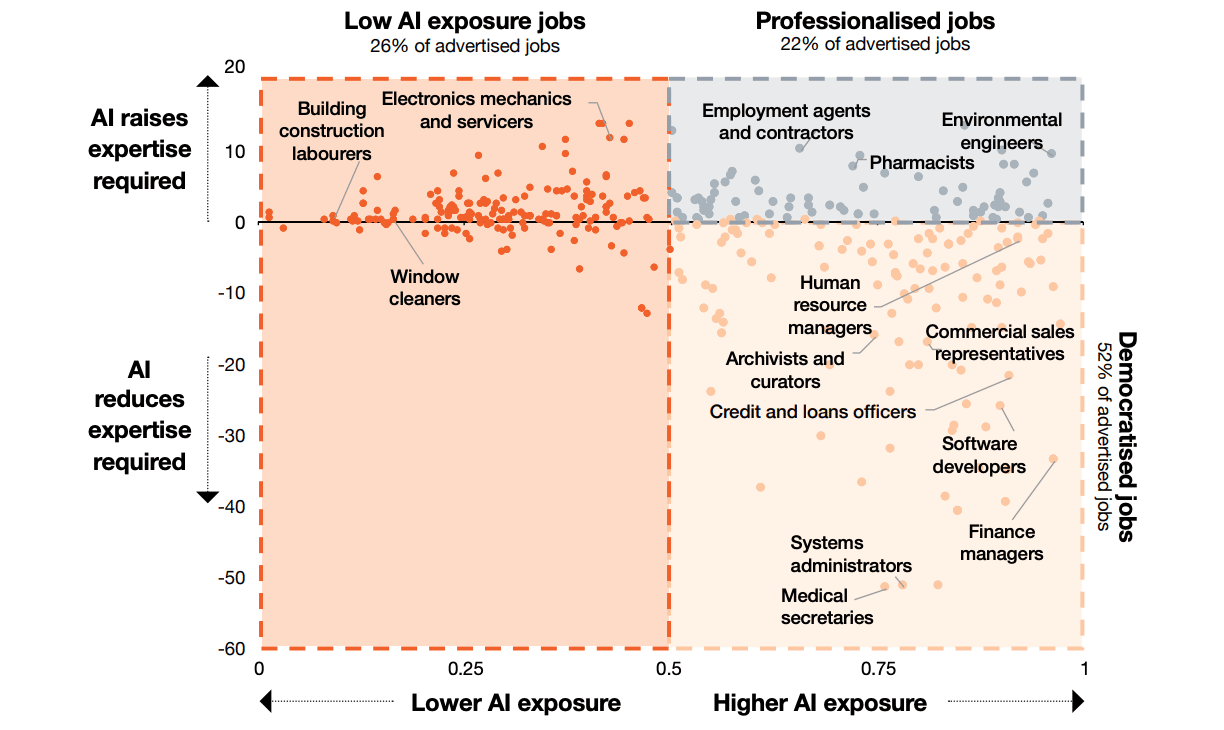
Humanisation - AI’s automating routine components elevates roles now emphasising the human judgment, experience, edge-thinking, empathy, and creativity. For example, radiologists, relieved of much pattern-scanning, can focus more on diagnostic judgment; and recruiters reduced screening workload allows them more time for talent assessment and relationship-building. Called ‘professionalisation‘ by PwC, 22% of roles are being ‘professionalised’.
Democratisation - AI’s augmenting roles by providing specialist capabilities is driving task crossover. AI offers reasonable data analysis, drafts legal-adjacent language, and generates acceptable code, allowing non-specialists to take on, and take over, specialist tasks. 52% of jobs are being ‘democratised’ (shifted toward less expert tasks) [PwC 2026 Global AI Jobs Barometer].
Consider the impact on your workforce as ‘professionalised’ roles are growing at 2x the rate of ‘democratised’ ones and commanding 42% faster salary growth. Moreover, the most AI-exposed junior roles are 7x more likely to need traditionally ‘senior’ skills, such as leadership, judgment, contextual reasoning, where greater automation has elevated human skills requirements [PwC, 2026]. How are you supporting early career professionals’ cultivate these skills?
As workflows are redesigned throughout your organisation, is your planning incorporating task crossovers and recognising how they are changing job scopes? Are you matching tasks with evolving roles, sometimes specific to an employee with particular skills or AI-enhanced capabilities?
Are you adjusting for how cross-functional tasks and job scope changes are mapping with employees needing to shift towards human judgment, synthesis, adaptability, and interpersonal skills?
Which roles in your organisation are being humanised or democratised?
Chains, Clusters & Conductors
The issue to solve for goes beyond redesigning workflows to incorporate isolated tasks crossovers enabled by AI. AI may be suited to extend further or accomplish more, bundling adjacent tasks. However, if AI struggles with just one task, it can break the chain.
“The concept of task chaining becomes critical” as well as “How tasks are clustered matters as much as which tasks are automated.” MIT Sloan ‘How AI is reshaping workflows and redefining jobs‘ April 2026.
These role shifts are ongoing as AI utilisation increases with experimentation of different (task) use cases. However, work redesign is lagging and workforce planning is inhibited as a result. How far has your company progressed in figuring out which chains or clusters of tasks should best be done by whom or what as skills develop and job scopes crossover?
At the same time, functions originally siloed for specialisation now need to collaborate closely for increased flexibility and flow in how capabilities and capacity are managed. 67% of leaders believe speed and responsiveness will be their primary competitive advantage over the next three years. Just 28% believe scale is the main differentiator [Deloitte, 2026].
“Organizations may need to rethink the very concept of functions. Rather than clinging to rigid silos, they have an opportunity to deconstruct traditional corporate functions and reassemble their capabilities around human and business outcomes.” Deloitte, 2026 Global Human Capital Trends.
Cross-functional design and coordination requires identifying, mapping, planning, monitoring, and adjusting for employees’ specific skills (now and as they evolve) and specific AI tools being used (now and as they evolve and usage changes). Initial intention and ongoing effort is required, and necessary to stay competitive especially if your company is older with less of a technology foundation. This is Work In Progress as only 40% of companies currently design for both business and human outcomes simultaneously.
Orchestrators are conductors of human-AI work who master this emerging cross-functional work, set parameters for AI agents, define where human judgement is needed, and translate between domains with sufficient fluency. Are you actively training any employees in early or maturing orchestrator roles?
In Practice
RISING LEADER & INDIVIDUAL CONTRIBUTOR
Audit task crossover: Look at your last month of AI use. Which tasks did you take on that nominally belong to another function — data analysis, legal drafts, tech troubleshooting, content creation? Map what you already do. Develop cross-functional work deliberate rather than accidental where it fits logically.
Learn adjacent domains: When you use AI to reach across domains, take extra steps to understand the framework behind the output. If AI gave you a financial model, understand what it is measuring and why. If it helped you draft a brief, understand what makes it legally sound. Judgment comes from understanding.
Classify and clarify: Cross-functional capability is still undervalued in performance conversations because workers do not name it explicitly. Start describing your work in terms of domains you bridge and tasks you complete.
TEAM LEADER
Redesign for task crossover: Map where your team is overlapping into adjacent functions. Discuss whether AI-enabled crossover closes the gap with deliberate upskilling. Plan in order to benefit from where work is flowing.
Set orchestration expectations: Define which team members are responsible for redesigning work integrating AI. Who is learning and accountable for workflow: task identification and sequencing, handoffs, judgment calls.
Calibrate cross-function flow: Where is crossover incoming or outgoing? Where is asymmetry causing specialist bottlenecks and where can prioritised cross-functional investment have the highest return?
SENIOR LEADER
Audit role architecture: What are the crossover flows? Is silos and job scopes creating bottlenecks because specialist tasks are not yet supported by AI-enabled access? How is democratisation shifting roles and work?
Design human-AI interaction: Create checkpoints where human judgment is needed in each consequential workflow? Who is accountable? What does ‘reviewed’ mean? Map cross-domain trends to reframe roles and track tasks.
Invest in orchestrators: Identify those already working substantially across functions, synthesising domains, and directing chains of tasks within human-AI workflows. Elevate these people to facilitate and model new skills and expertise.
News & Muse
📹 Tasks vs. Skills: Stories in AI-based Job Transformation, Josh Bersin
📘 Human + Machine, Reimagining Work in the Age of AI, Daughtery & Wilson
🗞️ How AI impacts the labour market, Seb Murray, MIT Sloan
🎶 Crossroads, Cream - exploring the intersections, expansions, evolutions.
Cross-functional shifts are shaping jobs as AI humanises and democratises work. Organisations and individuals who recognise and design deliberately for this — mapping task crossovers, building adjacent domain fluency, and learning coordinated orchestration — will excel beyond those treating AI as a productivity tool for existing job titles and specs.
See you again in two weeks.
Sophie