

Rework Middle Management
Reset mid-level roles. Rethink career tracks. Reassign skills-first.

Overworked and overwhelmed, what do your middle managers ‘do’: Check tasks are completed and projects on track? Monitor teams’ stress levels? Assess skills proficiencies and gaps? Plot non-linear career trajectories? Which ones are well-matched to their role? Who might be better deployed and where?
“It [AI] flattens the entire information flow. So once you start having that, you have to redesign structurally” argues @Satya Nadella, CEO of Microsoft, by creating a “complete inversion” of how information moves through a business.
Fixing Not Firing
The flattening of hierarchies is generally NOT focused on firing managers but fixing out-of-date analogue arrangements. While some employers are using AI, again, as the next catchall excuse for cavalier cost-cutting, others are redesigning and updating their organisation, and management, structure.
Amazon’s visible “massive restructuring plan to cut corporate bureaucracy” will also their “increase individual contributor ratio“ [HR Digest, Jan 2026].
Look at the details not the drama. The objective is to operate agile, responsive companies, with skills-first assigned talent involved in digitalised, updated (and AI-enhanced) processes with newly designed workflows.
‘Managing’ has been judged necessary to shepherd ‘work’ - work that was often not well-conceived or defined from the outset, but had to be shaped in progress. Project management tools can now clarify tasks and track progress.
Middle management has been a necessary step to cultivate and advance top talent into future leadership roles. However, middle management roles have NOT been where many excel. Managing should not be necessary to advance.
Only ~10% of people possess the talent to manage. Few people have the unique skills combination needed to help a team achieve excellence in a way that significantly improves company performance [Gallup].
Freitag, the company making cool bags out of ‘upcycled’ truck tarpaulins, adopted Holacracy as a non-hierarchical self-management system. Pascal Dulex was instrumental in implementing it. Listen to his opinions about the essence of leadership; the role of managers (as they were ‘clarified’ away), and how work processes were affected “The Evolving Roles of Leaders.”
A flatter structure focused on skills-based assignments of rising talent, utilising advanced tools, gives your organisation means to scale skills-first with agility.
#1: What percentage of your middle managers are really good at managing?
A Flatter Philosophy
In the 1990s, organisational design philosophy shifted model to a flatter structure, focused on reducing fixed layers of management hierarchy:
“Such a structure is becoming synonymous in popular management theory with bureaucracy busting, faster decision making, shorter communication paths, stimulating local innovation and a high involvement style of management.” IES, Is Flatter Better? 1995.
As digitisation ramped, companies implemented this design [Univ. Chicago, Rajan & Wulf 2006] with many-layered hierarchies replaced to allow greater operational flexibility to respond to pivots and changes. Last year, the trend continued as 41% of employees identified removal of management layers [Korn Ferry Workforce survey, 2025].
Handlesbanken is a very flat multinational financial services company. I had a fascinating conversation with Mikael Sorenson, CEO of Handelsbanken (UK) in 2021 about how leadership and management of a flat organisation works. Their trust-centred values are strong, and intently lived daily. Their overall philosophy and approach are unique.
As you rethink what works for your company, business and workforce, listen to how and why flatter works. Consider other ways your organisation might scale. “How Decentralized Organizations Profit from a Human-Centric Approach“.
Shallower Company Deeper Benefits
As companies reduced their hierarchical layers, middle managers’ spans of control widen. These managers must delegate more decision-making to their teams, disabled from micromanaging direct reports who must self-organise.
Empirical research from over 5,000 firms and 20 years reveals those thriving in flatter company structures are typically more conscientiousness, show high need for achievement, and drive new projects and initiatives:
2.0% increase in average workforce scores for conscientiousness;
3.6% rise in average agreeableness scores; and
3.4% improvement in openness [Reitzig & Heiss, study 2000-2022].
“Workforces feature a higher share of conscientious, agreeable, and open individuals a year after the company has de-layered its structure.“ Marcus Reitzig and Kathrin Heiss, ‘People Follow Structure: How Less Hierarchy Changes the Workforce‘, MIT Sloan, May 2025.
#2: Are hierarchies holding your company hostage?
Two Tracks
You have noticed promising emerging talent rise to the next level(s) and fail. Management was clearly NOT their thing. Maybe their people skills needed practice. Perhaps they just wanted to focus on their core strengths. Possibly they lost confidence and direction. Suboptimal hiccups and setbacks.
If becoming a manager is NOT the best next step for many of your rising top talent, what is? What other paths are possible to nurture future leaders?
“Management shouldn’t be a thing you have to do just to get ahead,” “We flipped this antiquated corporate thinking on its head to make sure that both crafters and managers can have a rich and fulfilling career at Shopify by creating two distinct career tracks for our employees.” Atlee Clark, VP Partnerships at Shopify.
Originally only seen in technical divisions, giving engineers a pathway to grow singular expertise, dual tracks are rising in popularity in non-technical roles. Dual tracks allow talent to grow, succeed, and increase their compensation without managerial responsibilities.
Shopify implemented dual tracks in March 2023 for individual contributors, or “crafters” as they are called, and managers. Since then, Shopify has leaders growing their careers comprising more crafters and fewer managers. The updated talent system aligns with the company’s priorities, allowing employees to focus on what they do best.
Shopify’s CEO, Tobias Lütke, has described the company as “craft centric.” The crafter track helps build product managers who are user-focused, take full ownership of problems and have high risk tolerance. They are intent on building better products, not increasing their team size and power.
“What we are seeing is some individuals are choosing and enjoying being in an organization where there is a choice between an individual contributor career path and a managerial career path.” - Bryan Hancock Partner at McKinsey and co-author of “Power to the Middle: Why Managers Hold the Key to the Future of Work”.
Remote, a global HR platform, has had dual tracks since inception recognising that companies need fewer managers than individual contributors. Both tracks have equal compensation growth. Employees can try out management and switch track, increasing retention as they continue to develop their careers.
Smaller companies are even more interested in this newer model to increase retention. Launch Potato, a digital media company, has a dual track system with clear expectations for individual contributors and managers at every level.
“It doesn’t make any sense when you like doing your job, and you’re really good at it, and then they take away your job from you to become a manager.“ “It helps you prevent competitiveness. It’s not like there’s one manager position you’re vying for.” - Job van der Voort, Co-founder and CEO of Remote.
November 2023, I interviewed Paul Wolfe, who was CHRO of Indeed for eight years and author of “Human Beings First“. We talked about his seasoned career in HR leadership. Check out “The People Journey to Human First Leadership“ episode, especially around 46:35 where we discuss individual contributor career path options.
#3: What issues could a dual track system solve at your company?
Orchestrator Options
Digital labour is already part of your workforce or coming soon. Agents aren’t ‘managed’ they are orchestrated. Their work is clearly defined and overseen by orchestration specialists to achieve full agent productivity.
Here’s a graphic I shared a few weeks ago, now with greater context for how the work and teams are being redesigned with AI integration. The blend of managers’ teams is evolving--here development teams specifically--as well as the skills larger and smaller teams’ managers need and their responsibilities.
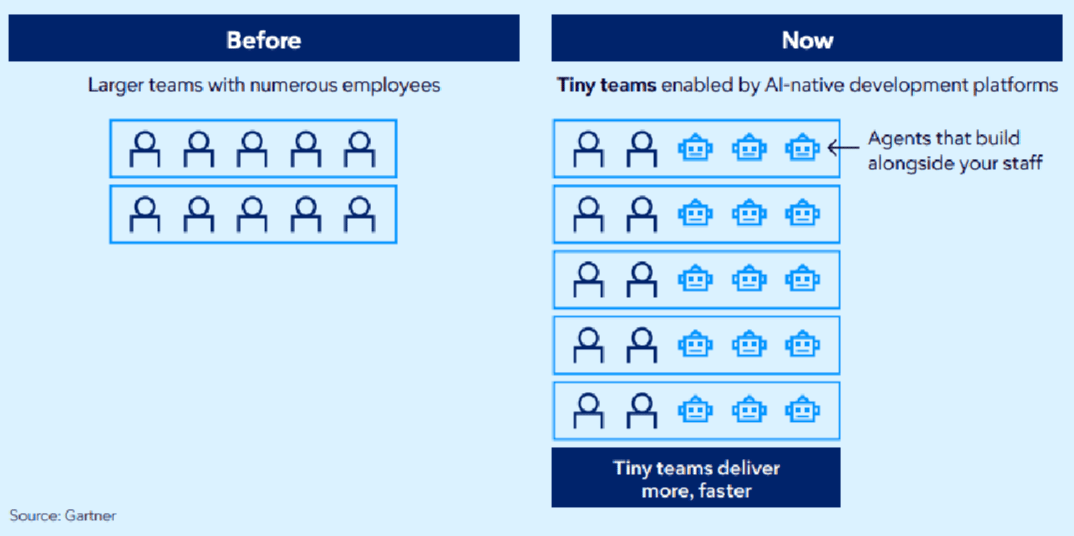
#4: How are development teams being managed with agentic AI integration?
Recalibrate & Update
Step back to consider how a smaller cohort of middle managers can oversee a blend of humans and agents doing (more) clearly defined and assigned work. Develop a dual career track system to advance non-managers in roles.
Your mid-level leaders need to ‘manage’ less and coach more, so they CAN transition to greater spans of control. Roles and responsibilities have already changed substantially as teams’ tasks are better articulated, allocated, and technically monitored. Direct reports have clear accountability and tracking.
With advanced existing project management tools (not excel spreadsheets), mid-level leaders can describe, assign, and delegate tasks and responsibilities to larger numbers of people. They can oversee, coach, support, and develop their teams, more individual contributors, and combined with AI agents.
Managers must be chosen based on their interpersonal, project management, and AI skills to determining the human-AI team composition of their oversight responsibilities. Others can advance in individual contributor parallel tracks.
#5 Find out how many (i) layers and (ii) middle managers your company needs?
MASTERING LEADERSHIP
Timeless Advice for C-Suite Executives.
Navid Nazemian is a coach, author, and influencer who loves to explore leadership, executive development and board effectiveness.
Read his latest newsletter with insights that “Teams fail 75% of the time - here’s why and what you can do about it.”
Nazemian is ranked as the world’s #1 Executive Coach by CEO Today.
Check out Navid’s leadership insights ->
News & Muse
📹 The Frontier Firm: How AI is Reshaping the Enterprise, Jared Spataro.
📘 Power to the Middle: Managers Hold the Keys to the Future of Work
🗞️ People Follow Structure: How Less Hierarchy Changes the Workforce.
🎶 Stuck in the Middle with You, Stealers Wheel - Get unstuck to scale!
Unclear assignments, skills mismatches, and outdated structures are preventing your company’s agility and growth. Capture the most AI value by redesigning, not slashing, middle management. Identify top managers, designate orchestrators, and create dual-track career paths.
AI-enabled middle management transformation is needed to overhaul your organisational structure. Discuss how your company can make the mid-level shifts necessary to scale. Click here to book a 45-minute session.
See you next week.
Sophie
If you’re interested to learn more about my work and insights:
modernworkLIFE.co -- My content hub, learning platform, and the place to book private leadership advisory sessions with me. Register to be notified when I add new content; it’s free.
YouTube -- Full versions, shorts, and clips of my interviews with global leaders navigating growth and change.
Substack -- A complete archive of my weekly “Work in Progress Report” newsletter, along with additional content for subscribers.
Podcast -- You can access my “Transforming Work” podcast episodes on Apple, Spotify, and iHeart.
Scalable strategies. Tactical talk. Workforce transformation.
Excellent analysis; your insights on organizational restructuring realy remind me of how well-designed algorithms optimize data structures, flattening information flow so effectively.